OUR CONSTITUTION: REALIZATION OF ITS VISION AND ASPIRATIONS
24 February, 202602:00:00 AM
V.SUDHISH PAI, Legal Luminary
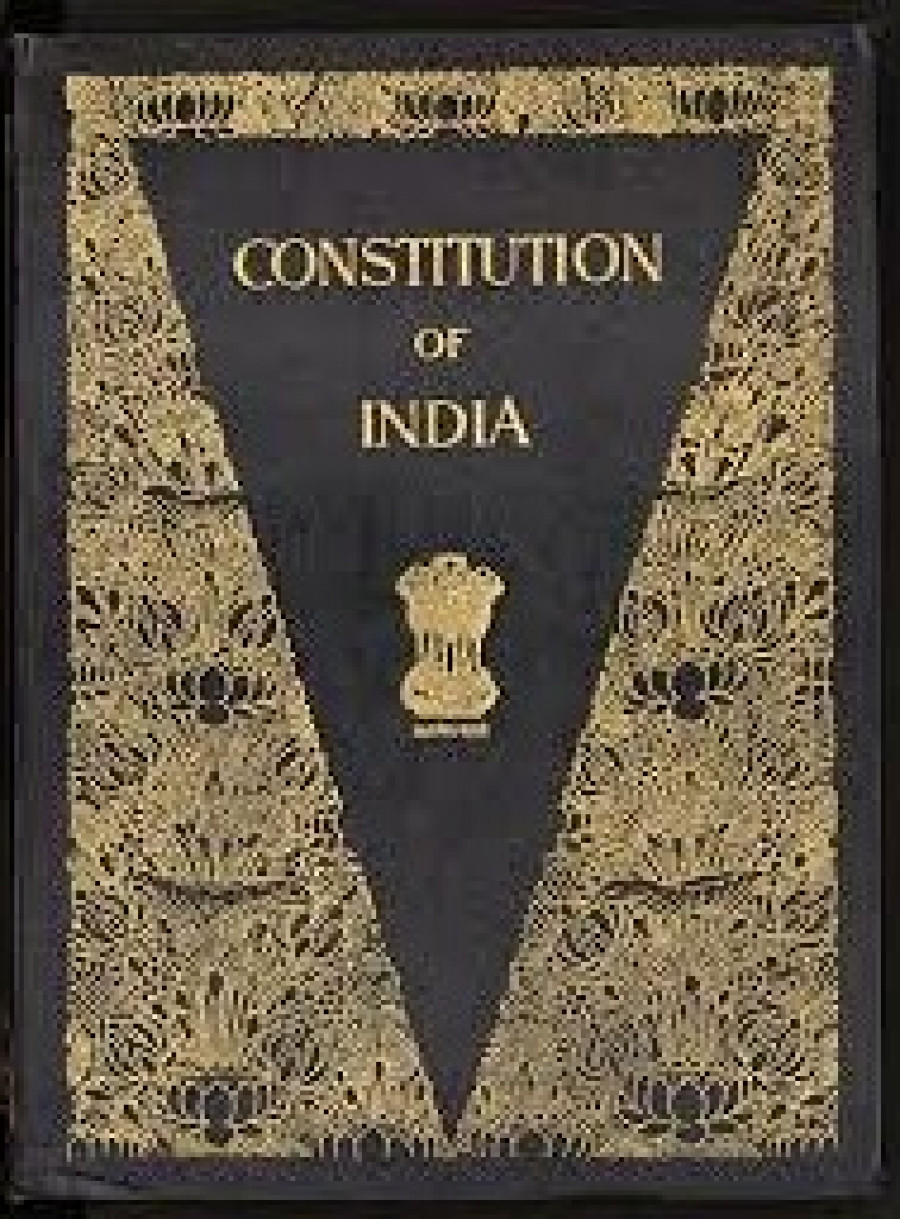
The Constitution of India is one of the most comprehensive and well-drafted in spite of its elephantine size. It is one of the finest products of human ingenuity. Our Constitution represents a summit of consensus in India’s political history. It manifests the best in our past traditions, provides a considered response to the needs and aspirations of the present, and possesses sufficient flexibility to handle and weather the requirements of the future. It is an instrument drawn with such meticulous care by a remarkably wise, articulate, and erudite pantheon of persons of outstanding abilities and backgrounds who “so well understood how to make language fit their thought and vision”.
The Constituent Assembly was composed of persons of the highest calibre drawn from different sections of society and representing various shades of opinion. The debates and discussions were of a very high order and profound, not marred by any narrow ideas or viewpoints. The deliberations reveal a very high level of political acumen and standard of debate. The presence and participation of such a vast, inclusive cross-section of the society imparted a non-partisan character to the deliberations, enhanced the Assembly’s authority, and facilitated the general acceptability of the Constitution. Accommodation and concord characterise and underpin our Constitution.
The Constituent Assembly met for the first time on 9 December 1946. The inaugural session was presided over by Dr Sachchidananda Sinha as provisional Chairman. He was an eminent legal scholar and a consummate advocate. He delivered an excellent inaugural address affirming his faith in the immortal destiny of India. Dr Rajendra Prasad was elected Chairman of the Constituent Assembly on 11 December 1946. The post was later designated as President. The Aims and Objectives Resolution drafted by Pt. Jawaharlal Nehru and moved by him on 13 December 1946 articulated the basic values of the Constitution to be drafted. Adopted on 22 January 1947, after a full-fledged debate and discussion, this resolution was the basis and inspiration for the Constitution.
On 29 August 1947, the Constituent Assembly appointed the Drafting Committee to draft the Constitution. At its first meeting on 30 August 1947, Dr B.R. Ambedkar was elected Chairman. The other members of the Committee were Alladi Krishnaswami Ayyar, N. Gopalaswami Ayyangar, K.M. Munshi, B.L. Mitter, D.P. Khaitan, Mohammad Sadulla. On Khaitan’s demise, his place was taken by T.T. Krishnamachari. N. Madhava Rau replaced Mitter, who resigned due to ill-health. The basic task of fashioning the Constitution was of this Committee. The Drafting Committee and the Constituent Assembly were ably assisted by the Assembly’s Secretariat. Two names, however, stand out and deserve special mention and compel our admiration and gratitude.
Sir Benegal Narsing Rau was the Constitutional Adviser to the Constituent Assembly and brought to his work his brilliance and rich experience. He prepared the first draft, which provided the basis for discussion. That draft had marginal notes of reference to the different constitutions. B.N. Rau travelled to various countries and held personal discussions with leading constitutional authorities there. B.N. Rau’s role in the making of the Constitution is seminal. Frankfurter J was so impressed with him that he remarked, “If the President of the United States were to ask me to recommend a judge for our Supreme Court on the strength of his knowledge of the history and working of the American Constitution, B.N. Rau would be the first on my list.” Indeed, great praise from high authority and very well deserved. Acknowledging Rau’s great contribution, Dr Ambedkar said, “The credit … belongs partly to Sir B.N. Rau, the Constitutional Adviser to the Constituent Assembly, who prepared a rough draft of the Constitution for the consideration of the Drafting Committee.” Dr Rajendra Prasad said that Rau “was the person who visualized the plan and laid the foundation of our Constitution”. “I must convey … my own thanks [and that] of the House to our Constitutional Adviser, Shri B.N. Rau, who worked honorarily all the time that he was here, assisting the Assembly not only with his knowledge and erudition but also enabled the other Members to perform their duties with thoroughness and intelligence by supplying them with the material on which they could work.”
The other person who shines in the galaxy and to whom the nation owes a deep debt of gratitude is Surendra Nath Mukherjee. S.N. Mukherjee was the Joint Secretary, Constituent Assembly, and the chief draftsman of the Constitution. It was he who meticulously drafted the various provisions of the Constitution that was finally adopted. Paying tribute to him in the Constituent Assembly on 25 November 1949, Dr Ambedkar said, “Much greater share of the credit must go to Mr. S.N. Mukherjee, the Chief Draftsman of the Constitution. His ability to put the most intricate proposals in the simplest and clearest legal form can rarely be equalled, nor his capacity for hard work. He has been an acquisition to the Assembly. Without his help, this Assembly would have taken many more years to finalise the Constitution.” Very high encomium and richly merited and earned. President Rajendra Prasad said on 26 November 1949, “Tribute has been paid justly to Shri S. N. Mukherjee who has proved of such invaluable help to the Drafting Committee.”
The original Draft Constitution prepared by Sir B.N. Rau and the Secretariat, containing 243 articles and 13 schedules, was ready by 7 October 1947. From 27 October 1947, the Drafting Committee sat daily scrutinising each clause of the draft until its own revised text with 315 articles and 7 schedules was ready in February, 1948. Wide publicity was given for the proposals and comments sought. The Constituent Assembly began the clause-by-clause consideration of the draft on 15 November 1948 and concluded on 17 October 1949. At the end of the consideration stage, there were 386 articles. There were 7635 amendments, of which 2473 were moved.
The deliberations continued till 26 November 1949, when the Constitution, as finally approved by the Assembly, was adopted with all fervour and enthusiasm. It contained 395 articles and 8 schedules. Some of the provisions came into effect that day itself. The Assembly’s sittings were spread over 1084 days—2 years, 11 months, 17 days. It held 11 sessions covering 165 days of which 114 days were devoted to the consideration of the Draft Constitution. The cost of the whole venture was Rs. 63, 96,729. Not less than 53,000 visitors were admitted to the Visitors’ Gallery when the Constitution was under consideration. 26 November is now celebrated as Constitution Day. The vast majority of the provisions of the Constitution came into force on 26 January 1950—Republic Day, when the Constitution was inaugurated. The Indian Independence Act, 1947 passed by the British Parliament was repealed, underscoring the idea of the Constitution being wholly Indian.
This, then, is the saga of the framing of our Constitution, which, according to Granville Austin, was “the greatest political venture since that originated in Philadelphia in 1787”.
Our Constitution has, undoubtedly, drawn from many sources; it is a happy blend of many strains. The Government of India act, 1935, in particular, is the edifice on which the Constitution has been raised. But there is nothing wrong in borrowing, in adopting ideas and adapting them. As Dr Ambedkar said, “There is nothing to be ashamed of in borrowing. It involves no plagiarism. Nobody holds any patent rights in the fundamental ideas of a Constitution.” As Voltaire put it profoundly, “Originality is nothing but judicious imitation. The most original writers borrowed one from another.”
There are two fundamental ideas that underpin the Constitution: The value of liberty—the idea that will and not force is the basis of government; and the value of justice—that right and not might is the basis of all political societies and of every system of political order.
The Constitution of India has established a sovereign, socialist, secular, democratic republic. It represents a charter of power granted by liberties and not a charter of liberty granted by power. Apart from providing a broad framework of government, it endeavours to protect liberties and secure justice. That is the constitutional vision and goal.
The Constitution has adopted a parliamentary system of government where the President/Governor is only a ceremonial head the real power vesting in the Prime Minister/Chief Minister heading the Council of Ministers on whose aid and advice alone the President/Governor acts. The basic tenets/features of the parliamentary system (cabinet government) are: (1) Primacy of the Prime Minister, (2) Accountability of the Government (executive branch) to the lower House of the legislature, (3) Collective responsibility.
It has set up a broad federal structure which is resilient enough to adjust according to the exigencies. There is a division of powers not only among the three wings but also between the Centre and the States. The basic principle of federalism is that the legislative and executive authority is partitioned between the Centre and the States by the Constitution itself. It is not by any law made by the Centre. Federal system is a means to accommodate the needs of a pluralistic society to function in a democratic manner, attempting to reconcile the desire of unity and commonality and the urge for diversity and autonomy.
None of the wings or units has a monopoly of wisdom, and in the pattern of functional distribution of State power, there is hardly any room for real supremacy. Limited government and judicial review constitute the essence of our constitutional system. It involves three main elements: 1) a written Constitution setting up and limiting the various organs of government; 2) the Constitution functioning as a superior law or standard by which the conduct of all organs of government is to be judged; 3) a sanction by means of which any violation of the superior law by any of the organs of government may be prevented or restrained and, if necessary, annulled. This sanction, in the modern constitutional world, is the “judicial review”, which means that a court of competent jurisdiction has the power to invalidate the act of any governmental agency, including the legislature, on the ground that it is repugnant to the Constitution. The court’s fidelity to the Constitution secures its own subordination, though it has the last word in the interpretation of the Constitution and it is the final judge of all acts purported to be done under the authority of the Constitution. But fidelity and creativity are not necessarily opposed; with devoted insight, they may enhance each other.
This, then, is our Constitution, which is described as “a precious heritage” by Chandrachud CJ in Minerva Mills Ltd. v. Union of India[1]. It has been described as a sublime Constitution by Mahajan CJ.
The constitutional experiments in India may be said to be a saga of statesmanship, hope, and faith. There were sublime moments in this task. There were also times of anguish, distrust, travail, and turmoil. But the overall response of the Indian State to the democratic aspirations of the people and the urges of Indian nationalism has been one of great satisfaction. Our failures, if any—and there are many—are attributable not to the Constitution but because, in Dr Ambedkar’s memorable words, “Man is vile.”
The Constitution is not just a legal document; it is first a social testament as also a political instrument. It may be said to provide for stability without stagnation and growth without destruction of essential values. A majority of the provisions are aimed at furthering the goals of the social revolution or attempt to foster the revolution by establishing the conditions necessary for its achievement. The core of this commitment lies in Parts III and IV which, together with Part IV-A and the Preamble, may be said to be the conscience of the Constitution; the judiciary is the conscience keeper. Arts 15, 17, 23 are some examples. The State has to obey the negative injunctions – not to interfere with the citizens’ liberties and also to fulfill the positive obligation to protect the citizens’ rights from encroachment by society. Fundamental rights are meant to foster the social revolution by creating a society egalitarian to the extent that all citizens are to be equally free from coercion or restriction by the State or by society privately. Fundamental rights were guaranteed to ensure that the liberty of the citizens of India would be a reality and not merely a promise. The inclusion of the directive principles of State policy in the Constitution assures to the citizens a better life wherein social and economic justice will be available. The Directive Principles aim at making the people free in the positive sense; they are to guide and be applied in making laws-fons juris. The Founding Fathers put the social revolution at the top of the agenda by adopting the Objectives Resolution. The judiciary was to be an arm of the social revolution with its duty to ‘keep the charter of government current with the times and not allow it to become archaic or out of tune with the needs of the day’ as Douglas, J. observed in his Tagore Law Lecture.
There have been many constitutional amendments but the more significant ones are as a result of battles over how the country should live up to its ideals. Preserving a balance among the strands of a seamless web was central to several of them. There were conundrums. Demands of the social revolutionary strand ran head on into other provisions in Part III with additionally critical implications for democracy. The Supreme Court ruled unconstitutional laws changing property relations. At the heart of the confrontation were issues crucial in any democracy, especially in India with its hierarchical social system, pre-dominantly agricultural economy, individual interest against national interest, one individual’s right against another, government’s role in reforming society, and conflicts between law and justice. What was to be the judiciary’s role and share in ordering the lives of a progressive people?
One of the major promises of the freedom struggle and the programmes of the new Government of independent India was to herald agrarian reforms which were vital to bringing about socio economic transformation and emancipation. With this end in view the State brought in Land Reforms legislation, particularly abolition of zamindari. But this came into conflict with the fundamental right to property in Art 19 (1) (f) and Art 31. In KameswarSingh’s case the Patna High Court declared unconstitutional the Bihar legislation. The judiciary appeared as the stumbling block on the road to social reconstruction. The political executive had to respond keeping in view its promises and the public sentiment.
Parliament-Provisional Parliament- in terms of Art 379 which consisted of the same persons who were members of the Constituent Assembly brought in the Constitution 1st Amendment Act introducing Art 31B and the device of IX Schedule. This was unanimously upheld in Shankari Prasad [2] holding that Constitution Amendment is not law under Art 13 and Parliament’s constituent power in amending the Constitution is unlimited. Art 19(6) was amended to provide for State monopoly in business in the public interest.
Originally Art 31(2) provided for payment of compensation for acquisition of property. Arts 31A and 31B and Schedule IX were inserted by the Constitution First Amendment to shield agrarian reforms and other nationalization schemes against attack on the ground of inadequacy of compensation. In Kameswar Singh[3] the Supreme Court held that though an attack on such ground was precluded, it did not bar an attack on the ground the compensation provided was so inadequate as to be illusory or amounting to no compensation. In Bela Banerjee[4] relating to the constitutionality of an urban development law not covered by Arts 31A & 31B it was held that compensation in Art 31(2) implied payment of full market value so as to fully indemnify the expropriated owner. The Constitution Fourth Amendment amended Art 31(2) and made the adequacy of compensation non-justiciable. But the Court still held in the Bank Nationalization case[5] that ‘compensation’ in Art 31(2) which still existed would signify only full compensation. The Constitution 25th Amendment substituted the word ‘amount’ for ‘compensation’ in Art 31(2). The Court again held that though the adequacy of the amount was not justiciable, it could still interfere where the amount was illusory or it was fixed on irrelevant principles. All this culminated in the right to property ceasing to be a fundamental right by the Constitution 44th Amendment.
As observed by the Supreme Court, “The Indian constitutional experiments with the right to property (Arts 19 (1) (f) & 31) offer an interesting illustration of how differences in the interpretation of the fundamental law sometimes conceal- or perhaps expose- conflicts of economic ideologies and philosophies. With the right to property conceived as a fundamental right at the inception of the Constitution, it found so strong an entrenchment that in its pristine vigour it tended to be overly demanding and sought the sacrifice of too many social and economic goals at its altar and made the economic cost of social and economic change unaffordably prohibitive. .... Inevitably the constitutional process of de-escalation of this right in the constitutional scale of values commenced culminating, ultimately, in the deletion of this right from the Fundamental Rights Part.”
Art 31 B and Schedule IX were intended to protect laws relating to land reforms from challenge on the ground of violation of fundamental rights. But the Constitution does not prescribe what categories of laws may be included in Schedule IX. It has been laid down in Coelho’s[6] case that all Constitution amendments after 24.4.1973 (the date of the Kesavananda judgment) by which laws are included in Schedule IX would be open to judicial review on the ground of violation of the basic structure.
The affirmative action of reservations in favour of the socially and educationally backward was struck down as offending the promise of equality under Art 14. The question was whether equality is just formal equality or equality that is meaningful. Art 15 was amended- Art 15(4) added by the Constitution 1st Amendment and Art 15(5) added by the Constitution 93rd Amendment.
The first fifteen years of the Supreme Court may be characterized as a conservative era. However, the Court while giving deference to legislative wisdom acted firmly in various areas in striking down impermissible legislations. But that was mainly in the area of fundamental rights related to property, trade and business and agrarian reforms. Of course, it was during this period that Art 14- the doctrine of equality- the concept of discrimination and the theory of classification were clearly evolved and that has stood the test of time. Freedom of the press as being included in the freedom of speech and expression was upheld. It has been said of the initial years of the Court that it was manned by a band of erudite and dedicated judges who in the cases before them generated a disciplined and learned debate free from bias and acrimony. Judicial power in their hands did not foreclose the future. The doors were often closed but not bolted. The judgments of that era set the tone and direction along which the Court made subsequent journeys and built the solid foundations for the future. The Court defined a range of concepts and principles and delineated the various parameters. The mid 1960s and thereafter saw a perceptible change with the Court adopting a more activist and dynamic approach.
In Golaknath[7] the Court had taken the extreme position that no fundamental right is amendable; that Constitutional Amendment is also law under Art 13 and it cannot fall foul of Part III. The Constitution 24th Amendment sought to undo them by amending both Art 13 & Art 368.The stage was set for the biggest and the most significant constitutional case-Kesavananda.[8] In Kesavananda Bharati the Supreme Court dexterously evolved the doctrine of basic structure which while holding that amendment of any part of the Constitution including Part III was permissible, sought to rein in that power by declaring that such amendment should not, however, destroy the basic features, framework or structure of the Constitution and what are basic features is for the Court to decide as and when situations and cases present themselves. Beginning with Kesavananda we see a marked difference in the Court’s perception of Part III vis-à-vis Part IV. The Court also had to move and did move with the times reflecting the general will and mood of the country.
The rights and values envisaged by the Constitution are not merely material. Constitutionalism implies limited government. Its history has been the movement from a culture of authority to one of justification where power and its exercise is made answerable. The judiciary, particularly the Supreme Court, as a vital institution of democratic governance has helped to inculcate and foster a constitutional culture and infuse all State actions with constitutional ethos. All seemingly wide and unfettered powers of the State are tempered by constitutional limitations to be exercised in accord with public law principles and subject to judicial review and correction depending on the nature of the function. This may be said to be of the very essence of the protection of civil and political liberties.
From Gopalan[9] to Cooper[10]and Maneka Gandhi[11] and beyond, and of course, Kesavananda, the Supreme Court took great strides in developing Constitutional law. The great theme in the history of our Constitutional law is the concept of law as a check upon public power. That idea has been given practical reality in the decisions of the Supreme Court. Those decisions are, to paraphrase Justice Holmes, a virtual magic mirror in which we see reflected our whole constitutional development and all that it has meant to the nation.
A shrewd US politician referring to their Constitution remarked, “We the People is a very eloquent beginning. But when that document was completed on 17.9.1787, I was not included in that We thePeople. I felt somehow for many years that George Washington and Alexander Hamilton just left me outside by mistake. But I realized that it is through the process of interpretation and Court decision that I have been finally included in We the People.” This also describes the role of the Indian judiciary particularly the Supreme Court. By interpretation and Court decision it has broadened the reach of the Constitution’s provisions and made them meaningful to the common man.
In India the scheme for the realization of the socio economic agenda comprises both the justiciable Fundamental Rights and the non- justiciable Directive Principles. The judicial contribution to their synthesis and integration has been crucial to the realization of the goals set out in Part IV both as a means to effectuate the rights guaranteed under Part III and also as a source of law for a welfare State. Civil liberties without economic freedom and progress can be counter-productive and an invitation to discontentment and chaos. It is against this backdrop that the State undertakes socio economic reforms and brings in legislation. The Constitution promised a peaceful revolution. The role of the judiciary assumes importance in the context of socio-economic rights as distinguished from personal freedoms. The judicial enforceability of these rights presupposes certain essential enforceable minimum standards. The Supreme Court, particularly after the first two decades, harmoniously interpreted Parts III and IV. Government’s constant reiteration of the social justice theme nurtured hopes. In a nation dedicated to the rule of law, the judiciary has great responsibilities and arouses great expectations. The judiciary has much to be proud of.
“What is fundamental in the governance of the country cannot be less significant than what is fundamental in the life of an individual.” It is this approach of balancing and harmonizing that has helped Indian society and the legal system to forge ahead with our social welfare measures endeavouring to create a climate of happiness and security. The various socio- economic rights and legislative measures in a way “represent the myriad lights and shades of India’s life, the contrasting tones of poverty and wealth and of bread so dear and flesh and blood so cheap, the deep tints of adventure and enterprise and man’s ageless struggle for a brighter morn.”
Judicial interpretation led to the reading into and inclusion of various rights as emanations successfully attempting to translate human rights rhetoric into action. The experience has been fascinating and heart-warming. The endeavour has been towards integration of Fundamental Rights and the Directives in the process of constitutionising socio economic rights. It may be said that Human Rights and Public Interest Litigation have reinforced each other. In the evolution of our constitutional and judicial experience there is evident a continuous flow of thought as to how values of human rights and international instruments can inspire constitutional interpretation for establishing and promoting an egalitarian society.
Natural justice came into its own and the distinction between administrative and quasi-judicial powers was obliterated. The right of being heard was held to be an essential requirement of all actions and orders having civil consequences. The Court spoke of non- arbitrariness in State action. The doctrine of promisory estoppel was placed on a firm foundation. Cases like Royappa[12],Maneka Gandhi,[13]Mohinder Singh Gill[14], Ramana Dayaram Shetty[15] carried much further the frontiers of Constitutional law and Administrative law, though petitioners therein did not get any relief. The right to life and liberty received an explosive expansion with cases of jail reforms and rights of under trials. The law, and particularly criminal law, was humanized. The evolving jurisprudence re: death sentence has infused this area of law with constitutional values. Article 21 reached its full plenitude when it was emphasized that life is not mere animal existence but it is to live with dignity and the inhibition against its deprivation extends to all limbs and faculties by which life is enjoyed. Remedy for public tort-- the award of compensation in writ jurisdiction for violation of Art 21 was recognized. Olga Tellis[16] is a classic example of second generation rights being judicially recognized and protected. Thereafter the Court has travelled far and wide in this direction.
The Constitution’s greatest gift to the social revolution and democracy has been an open society. The Constitution places the individual at the forefront of its focus, guaranteeing civil and political rights in Part III and embodying an aspiration for achieving social and economic rights in Part IV. In a constitutional democracy it is the right to question, to scrutinize and to dissent that enables an informed citizenry- the governed to scrutinize and rein in the government. The full growth and flowering of the human personality and the development of the community can take place far better in conditions of freedom. Development is not “merely the process of increasing inanimate objects of convenience”. The value of accomplishing such conveniences must depend on how it impacts on the life and freedom of the people- whether people have the ‘freedom to do what they have reason to value.’ Development is really expansion of people’s freedom. That is the blending of the guarantees in Part III and the objectives in Part IV. The overall societal good and welfare is to be achieved by the advancement and welfare of the individual. It is this which the Constitution seeks to achieve- stability without stagnation and growth without destruction of values. The golden triangle of Arts 14, 19 and 21 which the Supreme Court spoke of in Minerva Mills[17] is to be supported by the Directives to make life, which is more than mere animal existence, meaningful both in the material and spiritual sense. That is protecting and upholding both civil and political liberties. That is the constitutional vision and goal. The judiciary has been endeavouring, and to a large extent successfully, to realize this.
The Court has highlighted that the essential constituents of the right of access to justice are effective adjudicatory mechanism which is reasonably accessible in terms of distance and speedy and affordable adjudication. It has been observed that equality is not limited to the realm of executive action enforcing the law, it is available also in relation to proceedings before all adjudicatory fora where law is applied and justice administered. Direction banning the use of beacons on vehicles and other signs and symbols of authority contrary to the constitutional ethos is a welcome blow for egalitarianism, democratic principles and the basic idea of republicanism.
The Court has observed recently that ‘the constitutional policy of creating reservations subserves a high constitutional value of providing social redress and a life of dignity ….. but as a matter of principle, in the exercise of its constitutional jurisdiction, as the nation evolves, the role of the Court must be as an institution which abides by constitutional principle, enforces the rule of law and reaffirms the belief that claims based upon fraud, expediency and subterfuge will not be recognized.’ This again advances and helps entrench the constitutional vision of justice.
As Aharon Barak said a judge’s main tool is balancing and weighing which involves the duty to identify the values, the interest and the policies involved and to realize their relative importance at the point of conflict and thus give effect to the prevalent values and principles.
All this has been really commendable. Even if we fail in our search for complete justice (which is, of course, a remote ideal), mitigation of existing injustices in society, as Amartya Sen suggests, is no mean achievement. The role and contribution of the judiciary, especially the Apex Court, in this regard-in translating constitutional vision into reality has been quite outstanding. At the end of the day, in spite of some ups and downs and well meaning and justified criticisms, what was said about the American Supreme Court, “The Republic endures and this is the symbol of its faith”, truly applies to our Supreme Court as well.
Alkins, T. Ginsburg and J. Melton in their interesting and enlightening book, The Endurance of National Constitutions say that the average life span of a written constitution is 19 years; only a handful last longer than 50. The factors which help a constitution endure have been identified by them as specificity of its provisions, flexibility of the amending process and inclusiveness. And we may add a robust judicial process. Surrounded by neighbouring countries which are like deserts where constitutions have come and gone and a constitutional way of life is fanciful, India is an oasis: the Constitution is 76 years old, or we may say young.
The West was very wary of our adult franchise. They thought we would mess up the whole thing. We have our problems. They are serious. But we have worked our constitutional democracy: the same Western press after half a century referred to us as a robust, though boisterous democracy. The largest experiment undertaken in human history in the art of democratic living has been carried on in India for the last over seven decades. Never before and nowhere else has more than one-sixth of the human race lived as one political entity under conditions of freedom. Despite all the acrimony and mud-slinging and vituperative election campaigns, we have seen smooth successive changes in government after every election. The people’s verdict is accepted and given effect to. That is testimony to our successfully working the Constitution.
The Centennial Volume, "Fourteenth Amendment" edited by Bernard Schwartz, contains an article on "Landmarks of Legal Liberty" by Justice William J. Brennan in which he writes: In the service of the age-old dream for recognition of the equal and inalienable rights of man, the Fourteenth Amendment though 100 years old, can never be old. So it is with our Constitution and the Court.
We have worked our Constitution and to a large extent realized its vision and aspirations-politically, socially and economically. We have had our failures also. Some aspirations are a distant dream. We still have a long way to go. We, as a people and as government, ought to live by the Constitution imbibing its spirit and culture. A Constitution however ’living’ is inert. It does not ‘work’, it is worked -worked by human beings whose conduct it may shape, whose energies it may canalize, but whose character it cannot improve, and whose tasks it cannot perform. We cannot expect that, by some magic, reform would spring from the Constitution, rather than from the efforts of those using it and working it wisely. It is apposite to recall what Granville Austin said in his Working a DemocraticConstitution: ‘The Constitution has met India’s needs, the inadequacies in fulfilling its promise should be assigned to those working it and to conditions and circumstances that have defied greater economic and social reform, the country has achieved greatly against greater odds; and society and its hierarchical structure have shown themselves to be far more flexible and adaptable than might have been expected- due directly to incentives in the Constitution.’
More importantly, whatever our problems-and they are not absent- we cannot, and should not, think of changing, abandoning or replacing our system. We have only to endeavour to improve it. What was said by someone in a different context may be appropriately adapted: Our judicial system and process is not of architecture that one can re-engineer by knocking down a wall here or adding an extension there. It is a living, breathing system Its roots are ancient but it has evolved. It embodies a set of values, a legacy of understanding that has developed over the centuries. No one should lightly contemplate tampering with an institution/system that is so ancient and yet so alive.
Justice Vivian Bose’s words ring through the corridors of time: “We have received a rich heritage from a variegated past. But it is a treasure which can only be kept at the cost of ceaseless and watchful guarding. There is no room for complacency for in the absence of constant vigilance we run the risk of losing it.”[18] It was Edmund Burke who remarked, “Nobody makes a greater mistake than he who does nothing because he could do only a little.” Each one of us does matter.
[18]Bidi Supply Co. v Union of India, AIR 1956 SC 479, 488
02:00:00 AM {"id":1934,"user_id":3,"title":"OUR CONSTITUTION: REALIZATION OF ITS VISION AND ASPIRATIONS","slug":"our-constitution-realization-its-vision-and-aspirations","excerpt":"","content":"<p> <\/p>\r\n<p><img src=\"\/storage\/app\/media\/0%20sudhish%20pai\/cropped-images\/cropped-photo-2020-11-24-17-58-20-0-0-0-0-1771934676.png\" \/><\/p>\r\n<p>V.SUDHISH PAI,<br \/>Legal Luminary<\/p>\r\n<p>The Constitution of India is one of the most comprehensive and well-drafted in spite of its elephantine size. It is one of the finest products of human ingenuity. Our Constitution represents a summit of consensus in India’s political history. It manifests the best in our past traditions, provides a considered response to the needs and aspirations of the present, and possesses sufficient flexibility to handle and weather the requirements of the future. It is an instrument drawn with such meticulous care by a remarkably wise, articulate, and erudite pantheon of persons of outstanding abilities and backgrounds who “so well understood how to make language fit their thought and vision”.<\/p>\r\n<p>The Constituent Assembly was composed of persons of the highest calibre drawn from different sections of society and representing various shades of opinion. The debates and discussions were of a very high order and profound, not marred by any narrow ideas or viewpoints. The deliberations reveal a very high level of political acumen and standard of debate. The presence and participation of such a vast, inclusive cross-section of the society imparted a non-partisan character to the deliberations, enhanced the Assembly’s authority, and facilitated the general acceptability of the Constitution. Accommodation and concord characterise and underpin our Constitution.<\/p>\r\n<p>The Constituent Assembly met for the first time on 9 December 1946. The inaugural session was presided over by Dr Sachchidananda Sinha as provisional Chairman. He was an eminent legal scholar and a consummate advocate. He delivered an excellent inaugural address affirming his faith in the immortal destiny of India. Dr Rajendra Prasad was elected Chairman of the Constituent Assembly on 11 December 1946. The post was later designated as President. The Aims and Objectives Resolution drafted by Pt. Jawaharlal Nehru and moved by him on 13 December 1946 articulated the basic values of the Constitution to be drafted. Adopted on 22 January 1947, after a full-fledged debate and discussion, this resolution was the basis and inspiration for the Constitution.<\/p>\r\n<p>On 29 August 1947, the Constituent Assembly appointed the Drafting Committee to draft the Constitution. At its first meeting on 30 August 1947, Dr B.R. Ambedkar was elected Chairman. The other members of the Committee were Alladi Krishnaswami Ayyar, N. Gopalaswami Ayyangar, K.M. Munshi, B.L. Mitter, D.P. Khaitan, Mohammad Sadulla. On Khaitan’s demise, his place was taken by T.T. Krishnamachari. N. Madhava Rau replaced Mitter, who resigned due to ill-health. The basic task of fashioning the Constitution was of this Committee. The Drafting Committee and the Constituent Assembly were ably assisted by the Assembly’s Secretariat. Two names, however, stand out and deserve special mention and compel our admiration and gratitude. <\/p>\r\n<p>Sir Benegal Narsing Rau was the Constitutional Adviser to the Constituent Assembly and brought to his work his brilliance and rich experience. He prepared the first draft, which provided the basis for discussion. That draft had marginal notes of reference to the different constitutions. B.N. Rau travelled to various countries and held personal discussions with leading constitutional authorities there. B.N. Rau’s role in the making of the Constitution is seminal. Frankfurter J was so impressed with him that he remarked, “If the President of the United States were to ask me to recommend a judge for our Supreme Court on the strength of his knowledge of the history and working of the American Constitution, B.N. Rau would be the first on my list.” Indeed, great praise from high authority and very well deserved. Acknowledging Rau’s great contribution, Dr Ambedkar said, “The credit … belongs partly to Sir B.N. Rau, the Constitutional Adviser to the Constituent Assembly, who prepared a rough draft of the Constitution for the consideration of the Drafting Committee.” Dr Rajendra Prasad said that Rau “was the person who visualized the plan and laid the foundation of our Constitution”. “I must convey … my own thanks [and that] of the House to our Constitutional Adviser, Shri B.N. Rau, who worked honorarily all the time that he was here, assisting the Assembly not only with his knowledge and erudition but also enabled the other Members to perform their duties with thoroughness and intelligence by supplying them with the material on which they could work.”<\/p>\r\n<p style=\"text-align: center;\"><img src=\"\/storage\/app\/media\/0%20sudhish%20pai\/cropped-images\/WhatsApp%20Image%202026-02-24%20at%205.32.57%20PM-0-0-0-0-1771934605.jpeg\" \/><\/p>\r\n<p>The other person who shines in the galaxy and to whom the nation owes a deep debt of gratitude is Surendra Nath Mukherjee. S.N. Mukherjee was the Joint Secretary, Constituent Assembly, and the chief draftsman of the Constitution. It was he who meticulously drafted the various provisions of the Constitution that was finally adopted. Paying tribute to him in the Constituent Assembly on 25 November 1949, Dr Ambedkar said, “Much greater share of the credit must go to Mr. S.N. Mukherjee, the Chief Draftsman of the Constitution. His ability to put the most intricate proposals in the simplest and clearest legal form can rarely be equalled, nor his capacity for hard work. He has been an acquisition to the Assembly. Without his help, this Assembly would have taken many more years to finalise the Constitution.” Very high encomium and richly merited and earned. President Rajendra Prasad said on 26 November 1949, “Tribute has been paid justly to Shri S. N. Mukherjee who has proved of such invaluable help to the Drafting Committee.” <\/p>\r\n<p>The original Draft Constitution prepared by Sir B.N. Rau and the Secretariat, containing 243 articles and 13 schedules, was ready by 7 October 1947. From 27 October 1947, the Drafting Committee sat daily scrutinising each clause of the draft until its own revised text with 315 articles and 7 schedules was ready in February, 1948. Wide publicity was given for the proposals and comments sought. The Constituent Assembly began the clause-by-clause consideration of the draft on 15 November 1948 and concluded on 17 October 1949. At the end of the consideration stage, there were 386 articles. There were 7635 amendments, of which 2473 were moved.<\/p>\r\n<p>The deliberations continued till 26 November 1949, when the Constitution, as finally approved by the Assembly, was adopted with all fervour and enthusiasm. It contained 395 articles and 8 schedules. Some of the provisions came into effect that day itself. The Assembly’s sittings were spread over 1084 days—2 years, 11 months, 17 days. It held 11 sessions covering 165 days of which 114 days were devoted to the consideration of the Draft Constitution. The cost of the whole venture was Rs. 63, 96,729. Not less than 53,000 visitors were admitted to the Visitors’ Gallery when the Constitution was under consideration. 26 November is now celebrated as Constitution Day. The vast majority of the provisions of the Constitution came into force on 26 January 1950—Republic Day, when the Constitution was inaugurated. The Indian Independence Act, 1947 passed by the British Parliament was repealed, underscoring the idea of the Constitution being wholly Indian.<\/p>\r\n<p>This, then, is the saga of the framing of our Constitution, which, according to Granville Austin, was “the greatest political venture since that originated in Philadelphia in 1787”.<\/p>\r\n<p>Our Constitution has, undoubtedly, drawn from many sources; it is a happy blend of many strains. The Government of India act, 1935, in particular, is the edifice on which the Constitution has been raised. But there is nothing wrong in borrowing, in adopting ideas and adapting them. As Dr Ambedkar said, “There is nothing to be ashamed of in borrowing. It involves no plagiarism. Nobody holds any patent rights in the fundamental ideas of a Constitution.” As Voltaire put it profoundly, “Originality is nothing but judicious imitation. The most original writers borrowed one from another.”<\/p>\r\n<p>There are two fundamental ideas that underpin the Constitution: The value of liberty—the idea that <em>will<\/em> and not <em>force<\/em> is the basis of government; and the value of justice—that<em> right<\/em> and not <em>might<\/em> is the basis of all political societies and of every system of political order.<\/p>\r\n<p>The Constitution of India has established a sovereign, socialist, secular, democratic republic. It represents a charter of power granted by liberties and not a charter of liberty granted by power. Apart from providing a broad framework of government, it endeavours to protect liberties and secure justice. That is the constitutional vision and goal.<\/p>\r\n<p>The Constitution has adopted a parliamentary system of government where the President\/Governor is only a ceremonial head the real power vesting in the Prime Minister\/Chief Minister heading the Council of Ministers on whose aid and advice alone the President\/Governor acts. The basic tenets\/features of the parliamentary system (cabinet government) are: (1) Primacy of the Prime Minister, (2) Accountability of the Government (executive branch) to the lower House of the legislature, (3) Collective responsibility.<\/p>\r\n<p>It has set up a broad federal structure which is resilient enough to adjust according to the exigencies. There is a division of powers not only among the three wings but also between the Centre and the States. The basic principle of federalism is that the legislative and executive authority is partitioned between the Centre and the States by the Constitution itself. It is not by any law made by the Centre. Federal system is a means to accommodate the needs of a pluralistic society to function in a democratic manner, attempting to reconcile the desire of unity and commonality and the urge for diversity and autonomy.<\/p>\r\n<p>None of the wings or units has a monopoly of wisdom, and in the pattern of functional distribution of State power, there is hardly any room for real supremacy. Limited government and judicial review constitute the essence of our constitutional system. It involves three main elements: 1) a written Constitution setting up and limiting the various organs of government; 2) the Constitution functioning as a superior law or standard by which the conduct of all organs of government is to be judged; 3) a sanction by means of which any violation of the superior law by any of the organs of government may be prevented or restrained and, if necessary, annulled. This sanction, in the modern constitutional world, is the “judicial review”, which means that a court of competent jurisdiction has the power to invalidate the act of any governmental agency, including the legislature, on the ground that it is repugnant to the Constitution. The court’s fidelity to the Constitution secures its own subordination, though it has the last word in the interpretation of the Constitution and it is the final judge of all acts purported to be done under the authority of the Constitution. But fidelity and creativity are not necessarily opposed; with devoted insight, they may enhance each other.<\/p>\r\n<p>This, then, is our Constitution, which is described as “a precious heritage” by Chandrachud CJ in <em>Minerva Mills Ltd<\/em>. v. <em>Union of India<a href=\"#_ftn1\" name=\"_ftnref1\"><strong>[1]<\/strong><\/a><\/em>. It has been described as a sublime Constitution by Mahajan CJ.<\/p>\r\n<p>The constitutional experiments in India may be said to be a saga of statesmanship, hope, and faith. There were sublime moments in this task. There were also times of anguish, distrust, travail, and turmoil. But the overall response of the Indian State to the democratic aspirations of the people and the urges of Indian nationalism has been one of great satisfaction. Our failures, if any—and there are many—are attributable not to the Constitution but because, in Dr Ambedkar’s memorable words, “Man is vile.”<\/p>\r\n<p style=\"text-align: center;\"><img src=\"\/storage\/app\/media\/0%20sudhish%20pai\/cropped-images\/20260207_153843-0-0-0-0-1771933183.jpg\" \/><\/p>\r\n<p>The Constitution is not just a legal document; it is first a social testament as also a political instrument. It may be said to provide for stability without stagnation and growth without destruction of essential values. A majority of the provisions are aimed at furthering the goals of the social revolution or attempt to foster the revolution by establishing the conditions necessary for its achievement. The core of this commitment lies in Parts III and IV which, together with Part IV-A and the Preamble, may be said to be the conscience of the Constitution; the judiciary is the conscience keeper. Arts 15, 17, 23 are some examples. The State has to obey the negative injunctions – not to interfere with the citizens’ liberties and also to fulfill the positive obligation to protect the citizens’ rights from encroachment by society. Fundamental rights are meant to foster the social revolution by creating a society egalitarian to the extent that all citizens are to be equally free from coercion or restriction by the State or by society privately. Fundamental rights were guaranteed to ensure that the liberty of the citizens of India would be a reality and not merely a promise. The inclusion of the directive principles of State policy in the Constitution assures to the citizens a better life wherein social and economic justice will be available. The Directive Principles aim at making the people free in the positive sense; they are to guide and be applied in making laws-<em>fons juris<\/em>. The Founding Fathers put the social revolution at the top of the agenda by adopting the Objectives Resolution. The judiciary was to be an arm of the social revolution with its duty to ‘keep the charter of government current with the times and not allow it to become archaic or out of tune with the needs of the day’ as Douglas, J. observed in his Tagore Law Lecture.<\/p>\r\n<p>There have been many constitutional amendments but the more significant ones are as a result of battles over how the country should live up to its ideals. Preserving a balance among the strands of a seamless web was central to several of them. There were conundrums. Demands of the social revolutionary strand ran head on into other provisions in Part III with additionally critical implications for democracy. The Supreme Court ruled unconstitutional laws changing property relations. At the heart of the confrontation were issues crucial in any democracy, especially in India with its hierarchical social system, pre-dominantly agricultural economy, individual interest against national interest, one individual’s right against another, government’s role in reforming society, and conflicts between <em>law <\/em>and <em>justice.<\/em> What was to be the judiciary’s role and share in ordering the lives of a progressive people?<\/p>\r\n<p>One of the major promises of the freedom struggle and the programmes of the new Government of independent India was to herald agrarian reforms which were vital to bringing about socio economic transformation and emancipation. With this end in view the State brought in Land Reforms legislation, particularly abolition of zamindari. But this came into conflict with the fundamental right to property in Art 19 (1) (f) and Art 31. In <em>Kameswar<\/em> <em>Singh’<\/em>s case the Patna High Court declared unconstitutional the Bihar legislation. The judiciary appeared as the stumbling block on the road to social reconstruction. The political executive had to respond keeping in view its promises and the public sentiment.<\/p>\r\n<p>Parliament-Provisional Parliament- in terms of Art 379 which consisted of the same persons who were members of the Constituent Assembly brought in the Constitution 1<sup>st<\/sup> Amendment Act introducing Art 31B and the device of IX Schedule. This was unanimously upheld in <em>Shankari Prasad <a href=\"#_ftn2\" name=\"_ftnref2\"><strong>[2]<\/strong><\/a><\/em> holding that Constitution Amendment is not law under Art 13 and Parliament’s constituent power in amending the Constitution is unlimited. Art 19(6) was amended to provide for State monopoly in business in the public interest.<\/p>\r\n<p>Originally Art 31(2) provided for payment of compensation for acquisition of property. Arts 31A and 31B and Schedule IX were inserted by the Constitution First Amendment to shield agrarian reforms and other nationalization schemes against attack on the ground of inadequacy of compensation. In <em>Kameswar Singh<a href=\"#_ftn3\" name=\"_ftnref3\"><strong>[3]<\/strong><\/a><\/em> the Supreme Court held that though an attack on such ground was precluded, it did not bar an attack on the ground the compensation provided was so inadequate as to be illusory or amounting to no compensation. In <em>Bela Banerjee<a href=\"#_ftn4\" name=\"_ftnref4\"><strong>[4]<\/strong><\/a><\/em> relating to the constitutionality of an urban development law not covered by Arts 31A & 31B it was held that compensation in Art 31(2) implied payment of full market value so as to fully indemnify the expropriated owner. The Constitution Fourth Amendment amended Art 31(2) and made the adequacy of compensation non-justiciable. But the Court still held in the <em>Bank Nationalization<\/em> case<a href=\"#_ftn5\" name=\"_ftnref5\">[5]<\/a> that ‘compensation’ in Art 31(2) which still existed would signify only full compensation. The Constitution 25<sup>th<\/sup> Amendment substituted the word ‘amount’ for ‘compensation’ in Art 31(2). The Court again held that though the adequacy of the amount was not justiciable, it could still interfere where the amount was illusory or it was fixed on irrelevant principles. All this culminated in the right to property ceasing to be a fundamental right by the Constitution 44<sup>th<\/sup> Amendment.<\/p>\r\n<p>As observed by the Supreme Court, “The Indian constitutional experiments with the right to property (Arts 19 (1) (f) & 31) offer an interesting illustration of how differences in the interpretation of the fundamental law sometimes conceal- or perhaps expose- conflicts of economic ideologies and philosophies. With the right to property conceived as a fundamental right at the inception of the Constitution, it found so strong an entrenchment that in its pristine vigour it tended to be overly demanding and sought the sacrifice of too many social and economic goals at its altar and made the economic cost of social and economic change unaffordably prohibitive. .... Inevitably the constitutional process of de-escalation of this right in the constitutional scale of values commenced culminating, ultimately, in the deletion of this right from the Fundamental Rights Part.”<\/p>\r\n<p style=\"text-align: center;\"><img src=\"\/storage\/app\/media\/0%20sudhish%20pai\/cropped-images\/20260207_153838-0-0-0-0-1771933349.jpeg\" \/><\/p>\r\n<p>Art 31 B and Schedule IX were intended to protect laws relating to land reforms from challenge on the ground of violation of fundamental rights. But the Constitution does not prescribe what categories of laws may be included in Schedule IX. It has been laid down in <em>Coelho’s<\/em><a href=\"#_ftn6\" name=\"_ftnref6\">[6]<\/a> case that all Constitution amendments after 24.4.1973 (the date of the <em>Kesavananda<\/em> judgment) by which laws are included in Schedule IX would be open to judicial review on the ground of violation of the basic structure.<\/p>\r\n<p>The affirmative action of reservations in favour of the socially and educationally backward was struck down as offending the promise of equality under Art 14. The question was whether equality is just formal equality or equality that is meaningful. Art 15 was amended- Art 15(4) added by the Constitution 1<sup>st <\/sup>Amendment and Art 15(5) added by the Constitution 93<sup>rd<\/sup> Amendment.<\/p>\r\n<p>The first fifteen years of the Supreme Court may be characterized as a conservative era. However, the Court while giving deference to legislative wisdom acted firmly in various areas in striking down impermissible legislations. But that was mainly in the area of fundamental rights related to property, trade and business and agrarian reforms. Of course, it was during this period that Art 14- the doctrine of equality- the concept of discrimination and the theory of classification were clearly evolved and that has stood the test of time. Freedom of the press as being included in the freedom of speech and expression was upheld. It has been said of the initial years of the Court that it was manned by a band of erudite and dedicated judges who in the cases before them generated a disciplined and learned debate free from bias and acrimony. Judicial power in their hands did not foreclose the future. The doors were often closed but not bolted. The judgments of that era set the tone and direction along which the Court made subsequent journeys and built the solid foundations for the future. The Court defined a range of concepts and principles and delineated the various parameters. The mid 1960s and thereafter saw a perceptible change with the Court adopting a more activist and dynamic approach.<\/p>\r\n<p>In <em>Golaknath<a href=\"#_ftn7\" name=\"_ftnref7\"><strong>[7]<\/strong><\/a><\/em> the Court had taken the extreme position that no fundamental right is amendable; that Constitutional Amendment is also law under Art 13 and it cannot fall foul of Part III. The Constitution 24<sup>th<\/sup> Amendment sought to undo them by amending both Art 13 & Art 368.The stage was set for the biggest and the most significant constitutional case-<em>Kesavananda<\/em>.<a href=\"#_ftn8\" name=\"_ftnref8\">[8]<\/a> In <em>Kesavananda Bharati<\/em> the Supreme Court dexterously evolved the doctrine of basic structure which while holding that amendment of any part of the Constitution including Part III was permissible, sought to rein in that power by declaring that such amendment should not, however, destroy the basic features, framework or structure of the Constitution and what are basic features is for the Court to decide as and when situations and cases present themselves. Beginning with <em>Kesavananda<\/em> we see a marked difference in the Court’s perception of Part III vis-à-vis Part IV. The Court also had to move and did move with the times reflecting the general will and mood of the country.<\/p>\r\n<p>The rights and values envisaged by the Constitution are not merely material. Constitutionalism implies limited government. Its history has been the movement from a culture of authority to one of justification where power and its exercise is made answerable. The judiciary, particularly the Supreme Court, as a vital institution of democratic governance has helped to inculcate and foster a constitutional culture and infuse all State actions with constitutional ethos. All seemingly wide and unfettered powers of the State are tempered by constitutional limitations to be exercised in accord with public law principles and subject to judicial review and correction depending on the nature of the function. This may be said to be of the very essence of the protection of civil and political liberties.<\/p>\r\n<p>From <em>Gopalan<a href=\"#_ftn9\" name=\"_ftnref9\"><strong>[9]<\/strong><\/a><\/em> to <em>Cooper<a href=\"#_ftn10\" name=\"_ftnref10\"><strong>[10]<\/strong><\/a> <\/em>and <em>Maneka Gandhi<a href=\"#_ftn11\" name=\"_ftnref11\"><strong>[11]<\/strong><\/a><\/em> and beyond, and of course, <em>Kesavananda<\/em>, the Supreme Court took great strides in developing Constitutional law. The great theme in the history of our Constitutional law is the concept of law as a check upon public power. That idea has been given practical reality in the decisions of the Supreme Court. Those decisions are, to paraphrase Justice Holmes, a virtual magic mirror in which we see reflected our whole constitutional development and all that it has meant to the nation.<\/p>\r\n<p>A shrewd US politician referring to their Constitution remarked, “<em>We the People<\/em> is a very eloquent beginning. But when that document was completed on 17.9.1787, I was not included in that <em>We the<\/em> <em>People<\/em>. I felt somehow for many years that George Washington and Alexander Hamilton just left me outside by mistake. But I realized that it is through the process of interpretation and Court decision that I have been finally included in <em>We the People<\/em>.” This also describes the role of the Indian judiciary particularly the Supreme Court. By interpretation and Court decision it has broadened the reach of the Constitution’s provisions and made them meaningful to the common man.<\/p>\r\n<p>In India the scheme for the realization of the socio economic agenda comprises both the justiciable Fundamental Rights and the non- justiciable Directive Principles. The judicial contribution to their synthesis and integration has been crucial to the realization of the goals set out in Part IV both as a means to effectuate the rights guaranteed under Part III and also as a source of law for a welfare State. Civil liberties without economic freedom and progress can be counter-productive and an invitation to discontentment and chaos. It is against this backdrop that the State undertakes socio economic reforms and brings in legislation. The Constitution promised a peaceful revolution. The role of the judiciary assumes importance in the context of socio-economic rights as distinguished from personal freedoms. The judicial enforceability of these rights presupposes certain essential enforceable minimum standards. The Supreme Court, particularly after the first two decades, harmoniously interpreted Parts III and IV. Government’s constant reiteration of the social justice theme nurtured hopes. In a nation dedicated to the rule of law, the judiciary has great responsibilities and arouses great expectations. The judiciary has much to be proud of.<\/p>\r\n<p>“What is fundamental in the governance of the country cannot be less significant than what is fundamental in the life of an individual.” It is this approach of balancing and harmonizing that has helped Indian society and the legal system to forge ahead with our social welfare measures endeavouring to create a climate of happiness and security. The various socio- economic rights and legislative measures in a way “represent the myriad lights and shades of India’s life, the contrasting tones of poverty and wealth and of bread so dear and flesh and blood so cheap, the deep tints of adventure and enterprise and man’s ageless struggle for a brighter morn.”<\/p>\r\n<p>Judicial interpretation led to the reading into and inclusion of various rights as emanations successfully attempting to translate human rights rhetoric into action. The experience has been fascinating and heart-warming. The endeavour has been towards integration of Fundamental Rights and the Directives in the process of constitutionising socio economic rights. It may be said that Human Rights and Public Interest Litigation have reinforced each other. In the evolution of our constitutional and judicial experience there is evident a continuous flow of thought as to how values of human rights and international instruments can inspire constitutional interpretation for establishing and promoting an egalitarian society.<\/p>\r\n<p>Natural justice came into its own and the distinction between administrative and quasi-judicial powers was obliterated. The right of being heard was held to be an essential requirement of all actions and orders having civil consequences. The Court spoke of non- arbitrariness in State action. The doctrine of promisory estoppel was placed on a firm foundation. Cases like <em>Royappa<a href=\"#_ftn12\" name=\"_ftnref12\"><strong>[12]<\/strong><\/a>,<\/em> <em>Maneka Gandhi,<a href=\"#_ftn13\" name=\"_ftnref13\"><strong>[13]<\/strong><\/a><\/em> <em>Mohinder Singh Gill<a href=\"#_ftn14\" name=\"_ftnref14\"><strong>[14]<\/strong><\/a><\/em>, <em>Ramana Dayaram Shetty<a href=\"#_ftn15\" name=\"_ftnref15\"><strong>[15]<\/strong><\/a><\/em> carried much further the frontiers of Constitutional law and Administrative law, though petitioners therein did not get any relief. The right to life and liberty received an explosive expansion with cases of jail reforms and rights of under trials. The law, and particularly criminal law, was humanized. The evolving jurisprudence re: death sentence has infused this area of law with constitutional values. Article 21 reached its full plenitude when it was emphasized that life is not mere animal existence but it is to live with dignity and the inhibition against its deprivation extends to all limbs and faculties by which life is enjoyed. Remedy for public tort-- the award of compensation in writ jurisdiction for violation of Art 21 was recognized. <em>Olga Tellis<a href=\"#_ftn16\" name=\"_ftnref16\"><strong>[16]<\/strong><\/a><\/em> is a classic example of second generation rights being judicially recognized and protected. Thereafter the Court has travelled far and wide in this direction.<\/p>\r\n<p>The Constitution’s greatest gift to the social revolution and democracy has been an open society. The Constitution places the individual at the forefront of its focus, guaranteeing civil and political rights in Part III and embodying an aspiration for achieving social and economic rights in Part IV. In a constitutional democracy it is the right to question, to scrutinize and to dissent that enables an informed citizenry- the governed to scrutinize and rein in the government. The full growth and flowering of the human personality and the development of the community can take place far better in conditions of freedom. Development is not “merely the process of increasing inanimate objects of convenience”. The value of accomplishing such conveniences must depend on how it impacts on the life and freedom of the people- whether people have the ‘freedom to do what they have reason to value.’ Development is really expansion of people’s freedom. That is the blending of the guarantees in Part III and the objectives in Part IV. The overall societal good and welfare is to be achieved by the advancement and welfare of the individual. It is this which the Constitution seeks to achieve- stability without stagnation and growth without destruction of values. The golden triangle of Arts 14, 19 and 21 which the Supreme Court spoke of in <em>Minerva Mills<a href=\"#_ftn17\" name=\"_ftnref17\"><strong>[17]<\/strong><\/a><\/em> is to be supported by the Directives to make life, which is more than mere animal existence, meaningful both in the material and spiritual sense. That is protecting and upholding both civil and political liberties. That is the constitutional vision and goal. The judiciary has been endeavouring, and to a large extent successfully, to realize this.<\/p>\r\n<p style=\"text-align: center;\"><img src=\"\/storage\/app\/media\/0%20sudhish%20pai\/cropped-images\/20260207_153932-0-0-0-0-1771934171.jpg\" \/><\/p>\r\n<p>The Court has highlighted that the essential constituents of the right of access to justice are effective adjudicatory mechanism which is reasonably accessible in terms of distance and speedy and affordable adjudication. It has been observed that equality is not limited to the realm of executive action enforcing the law, it is available also in relation to proceedings before all adjudicatory fora where law is applied and justice administered. Direction banning the use of beacons on vehicles and other signs and symbols of authority contrary to the constitutional ethos is a welcome blow for egalitarianism, democratic principles and the basic idea of republicanism.<\/p>\r\n<p>The Court has observed recently that ‘the constitutional policy of creating reservations subserves a high constitutional value of providing social redress and a life of dignity ….. but as a matter of principle, in the exercise of its constitutional jurisdiction, as the nation evolves, the role of the Court must be as an institution which abides by constitutional principle, enforces the rule of law and reaffirms the belief that claims based upon fraud, expediency and subterfuge will not be recognized.’ This again advances and helps entrench the constitutional vision of justice.<\/p>\r\n<p>As Aharon Barak said a judge’s main tool is balancing and weighing which involves the duty to identify the values, the interest and the policies involved and to realize their relative importance at the point of conflict and thus give effect to the prevalent values and principles.<\/p>\r\n<p>All this has been really commendable. Even if we fail in our search for complete justice (which is, of course, a remote ideal), mitigation of existing injustices in society, as Amartya Sen suggests, is no mean achievement. The role and contribution of the judiciary, especially the Apex Court, in this regard-in translating constitutional vision into reality has been quite outstanding. At the end of the day, in spite of some ups and downs and well meaning and justified criticisms, what was said about the American Supreme Court, “The Republic endures and this is the symbol of its faith”, truly applies to our Supreme Court as well.<\/p>\r\n<p>Alkins, T. Ginsburg and J. Melton in their interesting and enlightening book, <em>The Endurance of National Constitutions<\/em> say that the average life span of a written constitution is 19 years; only a handful last longer than 50. The factors which help a constitution endure have been identified by them as specificity of its provisions, flexibility of the amending process and inclusiveness. And we may add a robust judicial process. Surrounded by neighbouring countries which are like deserts where constitutions have come and gone and a constitutional way of life is fanciful, India is an oasis: the Constitution is 76 years old, or we may say young.<\/p>\r\n<p>The West was very wary of our adult franchise. They thought we would mess up the whole thing. We have our problems. They are serious. But we have worked our constitutional democracy: the same Western press after half a century referred to us as a robust, though boisterous democracy. The largest experiment undertaken in human history in the art of democratic living has been carried on in India for the last over seven decades. Never before and nowhere else has more than one-sixth of the human race lived as one political entity under conditions of freedom. Despite all the acrimony and mud-slinging and vituperative election campaigns, we have seen smooth successive changes in government after every election. The people’s verdict is accepted and given effect to. That is testimony to our successfully working the Constitution.<\/p>\r\n<p>The Centennial Volume, <em>\"Fourteenth Amendment\"<\/em> edited by Bernard Schwartz, contains an article on \"Landmarks of Legal Liberty\" by Justice William J. Brennan in which he writes: In the service of the age-old dream for recognition of the equal and inalienable rights of man, the Fourteenth Amendment though 100 years old, can never be old. So it is with our Constitution and the Court.<\/p>\r\n<p>We have worked our Constitution and to a large extent realized its vision and aspirations-politically, socially and economically. We have had our failures also. Some aspirations are a distant dream. We still have a long way to go. We, as a people and as government, ought to live by the Constitution imbibing its spirit and culture. A Constitution however ’living’ is inert. It does not ‘work’, it is worked -worked by human beings whose conduct it may shape, whose energies it may canalize, but whose character it cannot improve, and whose tasks it cannot perform. We cannot expect that, by some magic, reform would spring from the Constitution, rather than from the efforts of those using it and working it wisely. It is apposite to recall what Granville Austin said in his <em>Working a Democratic<\/em> <em>Constitution<\/em>: ‘The Constitution has met India’s needs, the inadequacies in fulfilling its promise should be assigned to those working it and to conditions and circumstances that have defied greater economic and social reform, the country has achieved greatly against greater odds; and society and its hierarchical structure have shown themselves to be far more flexible and adaptable than might have been expected- due directly to incentives in the Constitution.’<\/p>\r\n<p>More importantly, whatever our problems-and they are not absent- we cannot, and should not, think of changing, abandoning or replacing our system. We have only to endeavour to improve it. What was said by someone in a different context may be appropriately adapted: Our judicial system and process is not of architecture that one can re-engineer by knocking down a wall here or adding an extension there. It is a living, breathing system Its roots are ancient but it has evolved. It embodies a set of values, a legacy of understanding that has developed over the centuries. No one should lightly contemplate tampering with an institution\/system that is so ancient and yet so alive.<\/p>\r\n<p>Justice Vivian Bose’s words ring through the corridors of time: “We have received a rich heritage from a variegated past. But it is a treasure which can only be kept at the cost of ceaseless and watchful guarding. There is no room for complacency for in the absence of constant vigilance we run the risk of losing it.”<a href=\"#_ftn18\" name=\"_ftnref18\">[18]<\/a> It was Edmund Burke who remarked, “Nobody makes a greater mistake than he who does nothing because he could do only a little.” Each one of us does matter. <br \/> <\/p>\r\n<p> <\/p>\r\n<p><a href=\"#_ftnref1\" name=\"_ftn1\">[1]<\/a> AIR 1980 SC 1789<\/p>\r\n<p><a href=\"#_ftnref2\" name=\"_ftn2\">[2]<\/a> AIR 1951 SC 458<\/p>\r\n<p><a href=\"#_ftnref3\" name=\"_ftn3\">[3]<\/a> AIR 1952 SC 252<\/p>\r\n<p><a href=\"#_ftnref4\" name=\"_ftn4\">[4]<\/a> AIR 1954 SC 170<\/p>\r\n<p><a href=\"#_ftnref5\" name=\"_ftn5\">[5]<\/a> AIR 1970 SC 564<\/p>\r\n<p><a href=\"#_ftnref6\" name=\"_ftn6\"><\/a>7 ( (2007) 2 SCC 1<\/p>\r\n<p><a href=\"#_ftnref7\" name=\"_ftn7\">[7]<\/a> AIR 1967 SC1643<\/p>\r\n<p><a href=\"#_ftnref8\" name=\"_ftn8\">[8]<\/a> AIR 1973 SC 1461<\/p>\r\n<p><a href=\"#_ftnref9\" name=\"_ftn9\">[9]<\/a> AIR 1950 SC 27<\/p>\r\n<p><a href=\"#_ftnref10\" name=\"_ftn10\">[10]<\/a> supra 6<\/p>\r\n<p><a href=\"#_ftnref11\" name=\"_ftn11\">[11]<\/a> AIR 1978 SC 597<\/p>\r\n<p><a href=\"#_ftnref12\" name=\"_ftn12\">[12]<\/a> AIR 1974 SC 555<\/p>\r\n<p><a href=\"#_ftnref13\" name=\"_ftn13\">[13]<\/a> supra 12<\/p>\r\n<p><a href=\"#_ftnref14\" name=\"_ftn14\">[14]<\/a> AIR 1978 SC 851<\/p>\r\n<p><a href=\"#_ftnref15\" name=\"_ftn15\">[15]<\/a> AIR 1979 SC 1628<\/p>\r\n<p> <\/p>\r\n<p><a href=\"#_ftnref16\" name=\"_ftn16\">[16]<\/a> AIR 1986 SC 180<\/p>\r\n<p><a href=\"#_ftnref17\" name=\"_ftn17\">[17]<\/a> Supra 1<\/p>\r\n<p><a href=\"#_ftnref18\" name=\"_ftn18\">[18]<\/a> <em>Bidi Supply Co<\/em>. v <em>Union of India<\/em>, AIR 1956 SC 479, 488<\/p>\r\n<p> <\/p>\r\n<p> <\/p>\r\n<p><a href=\"#_ftnref1\" name=\"_ftn1\">[1]<\/a> AIR 1980 SC 1789<\/p>\r\n<p><a href=\"#_ftnref2\" name=\"_ftn2\">[2]<\/a> AIR 1951 SC 458<\/p>\r\n<p><a href=\"#_ftnref3\" name=\"_ftn3\">[3]<\/a> AIR 1952 SC 252<\/p>\r\n<p><a href=\"#_ftnref4\" name=\"_ftn4\">[4]<\/a> AIR 1954 SC 170<\/p>\r\n<p><a href=\"#_ftnref5\" name=\"_ftn5\">[5]<\/a> AIR 1970 SC 564<\/p>\r\n<p><a href=\"#_ftnref6\" name=\"_ftn6\"><\/a>7 ( (2007) 2 SCC 1<\/p>\r\n<p><a href=\"#_ftnref7\" name=\"_ftn7\">[7]<\/a> AIR 1967 SC1643<\/p>\r\n<p><a href=\"#_ftnref8\" name=\"_ftn8\">[8]<\/a> AIR 1973 SC 1461<\/p>\r\n<p><a href=\"#_ftnref9\" name=\"_ftn9\">[9]<\/a> AIR 1950 SC 27<\/p>\r\n<p><a href=\"#_ftnref10\" name=\"_ftn10\">[10]<\/a> supra 6<\/p>\r\n<p><a href=\"#_ftnref11\" name=\"_ftn11\">[11]<\/a> AIR 1978 SC 597<\/p>\r\n<p><a href=\"#_ftnref12\" name=\"_ftn12\">[12]<\/a> AIR 1974 SC 555<\/p>\r\n<p><a href=\"#_ftnref13\" name=\"_ftn13\">[13]<\/a> supra 12<\/p>\r\n<p><a href=\"#_ftnref14\" name=\"_ftn14\">[14]<\/a> AIR 1978 SC 851<\/p>\r\n<p><a href=\"#_ftnref15\" name=\"_ftn15\">[15]<\/a> AIR 1979 SC 1628<\/p>\r\n<p> <\/p>\r\n<p><a href=\"#_ftnref16\" name=\"_ftn16\">[16]<\/a> AIR 1986 SC 180<\/p>\r\n<p><a href=\"#_ftnref17\" name=\"_ftn17\">[17]<\/a> Supra 1<\/p>\r\n<p><a href=\"#_ftnref18\" name=\"_ftn18\">[18]<\/a> <em>Bidi Supply Co<\/em>. v <em>Union of India<\/em>, AIR 1956 SC 479, 488<\/p>\r\n<p><em>References:<\/em><\/p>\r\n<p><a href=\"#_ftnref1\" name=\"_ftn1\">[1]<\/a> AIR 1980 SC 1789<\/p>\r\n<p><a href=\"#_ftnref2\" name=\"_ftn2\">[2]<\/a> AIR 1951 SC 458<\/p>\r\n<p><a href=\"#_ftnref3\" name=\"_ftn3\">[3]<\/a> AIR 1952 SC 252<\/p>\r\n<p><a href=\"#_ftnref4\" name=\"_ftn4\">[4]<\/a> AIR 1954 SC 170<\/p>\r\n<p><a href=\"#_ftnref5\" name=\"_ftn5\">[5]<\/a> AIR 1970 SC 564<\/p>\r\n<p><a href=\"#_ftnref6\" name=\"_ftn6\"><\/a><a href=\"#_ftn6\" name=\"_ftnref6\">[6]<\/a> ( (2007) 2 SCC 1<\/p>\r\n<p><a href=\"#_ftnref7\" name=\"_ftn7\">[7]<\/a> AIR 1967 SC1643<\/p>\r\n<p><a href=\"#_ftnref8\" name=\"_ftn8\">[8]<\/a> AIR 1973 SC 1461<\/p>\r\n<p><a href=\"#_ftnref9\" name=\"_ftn9\">[9]<\/a> AIR 1950 SC 27<\/p>\r\n<p><a href=\"#_ftnref10\" name=\"_ftn10\">[10]<\/a> supra 6<\/p>\r\n<p><a href=\"#_ftnref11\" name=\"_ftn11\">[11]<\/a> AIR 1978 SC 597<\/p>\r\n<p><a href=\"#_ftnref12\" name=\"_ftn12\">[12]<\/a> AIR 1974 SC 555<\/p>\r\n<p><a href=\"#_ftnref13\" name=\"_ftn13\">[13]<\/a> supra 12<\/p>\r\n<p><a href=\"#_ftnref14\" name=\"_ftn14\">[14]<\/a> AIR 1978 SC 851<\/p>\r\n<p><a href=\"#_ftnref15\" name=\"_ftn15\">[15]<\/a> AIR 1979 SC 1628<\/p>\r\n<p><a href=\"#_ftnref16\" name=\"_ftn16\">[16]<\/a> AIR 1986 SC 180<\/p>\r\n<p><a href=\"#_ftnref17\" name=\"_ftn17\">[17]<\/a> Supra 1<\/p>\r\n<p><a href=\"#_ftnref18\" name=\"_ftn18\">[18]<\/a> <em>Bidi Supply Co<\/em>. v <em>Union of India<\/em>, AIR 1956 SC 479, 488<\/p>","content_html":"<p>\u00a0<\/p>\n<p><img src=\"\/storage\/app\/media\/0%20sudhish%20pai\/cropped-images\/cropped-photo-2020-11-24-17-58-20-0-0-0-0-1771934676.png\"><\/p>\n<p>V.SUDHISH PAI,<br>Legal Luminary<\/p>\n<p>The Constitution of India is one of the most comprehensive and well-drafted in spite of its elephantine size. It is one of the finest products of human ingenuity. Our Constitution represents a summit of consensus in India\u2019s political history. It manifests the best in our past traditions, provides a considered response to the needs and aspirations of the present, and possesses sufficient flexibility to handle and weather the requirements of the future. It is an instrument drawn with such meticulous care by a remarkably wise, articulate, and erudite pantheon of persons of outstanding abilities and backgrounds who \u201cso well understood how to make language fit their thought and vision\u201d.<\/p>\n<p>The Constituent Assembly was composed of persons of the highest calibre drawn from different sections of society and representing various shades of opinion. The debates and discussions were of a very high order and profound, not marred by any narrow ideas or viewpoints. The deliberations reveal a very high level of political acumen and standard of debate. The presence and participation of such a vast, inclusive cross-section of the society imparted a non-partisan character to the deliberations, enhanced the Assembly\u2019s authority, and facilitated the general acceptability of the Constitution. Accommodation and concord characterise and underpin our Constitution.<\/p>\n<p>The Constituent Assembly met for the first time on 9 December 1946. \u00a0The inaugural session was presided over by Dr Sachchidananda Sinha as provisional Chairman. He was an eminent legal scholar and a consummate advocate. He delivered an excellent inaugural address affirming his faith in the immortal destiny of India. \u00a0Dr Rajendra Prasad was elected Chairman of the Constituent Assembly on 11 December 1946. The post was later designated as President. The Aims and Objectives Resolution drafted by Pt. Jawaharlal Nehru and moved by him on 13 December 1946 articulated the basic values of the Constitution to be drafted. Adopted on 22 January 1947, after a full-fledged debate and discussion, this resolution was the basis and inspiration for the Constitution.<\/p>\n<p>On 29 August 1947, the Constituent Assembly appointed the Drafting Committee to draft the Constitution. At its first meeting on 30 August 1947, Dr B.R. Ambedkar was elected Chairman. The other members of the Committee were Alladi Krishnaswami Ayyar, N. Gopalaswami Ayyangar, K.M. Munshi, B.L. Mitter, D.P. Khaitan, Mohammad Sadulla. On Khaitan\u2019s demise, his place was taken by T.T. Krishnamachari. N. Madhava Rau replaced Mitter, who resigned due to ill-health. The basic task of fashioning the Constitution was of this Committee. The Drafting Committee and the Constituent Assembly were ably assisted by the Assembly\u2019s Secretariat. Two names, however, stand out and deserve special mention and compel our admiration and gratitude.\u00a0<\/p>\n<p>Sir Benegal Narsing Rau was the Constitutional Adviser to the Constituent Assembly and brought to his work his brilliance and rich experience. He prepared the first draft, which provided the basis for discussion. That draft had marginal notes of reference to the different constitutions. B.N. Rau travelled to various countries and held personal discussions with leading constitutional authorities there. B.N. Rau\u2019s role in the making of the Constitution is seminal. Frankfurter J was so impressed with him that he remarked, \u201cIf the President of the United States were to ask me to recommend a judge for our Supreme Court on the strength of his knowledge of the history and working of the American Constitution, B.N. Rau would be the first on my list.\u201d Indeed, great praise from high authority and very well deserved. Acknowledging Rau\u2019s great contribution, Dr Ambedkar said, \u201cThe credit \u2026 belongs partly to Sir B.N. Rau, the Constitutional Adviser to the Constituent Assembly, who prepared a rough draft of the Constitution for the consideration of the Drafting Committee.\u201d\u00a0 Dr Rajendra Prasad said that Rau \u201cwas the person who visualized the plan and laid the foundation of our Constitution\u201d. \u201cI must convey \u2026 my own thanks [and that] of the House to our Constitutional Adviser, Shri B.N. Rau, who worked honorarily all the time that he was here, assisting the Assembly not only with his knowledge and erudition but also enabled the other Members to perform their duties with thoroughness and intelligence by supplying them with the material on which they could work.\u201d<\/p>\n<p style=\"text-align: center;\"><img src=\"\/storage\/app\/media\/0%20sudhish%20pai\/cropped-images\/WhatsApp%20Image%202026-02-24%20at%205.32.57%20PM-0-0-0-0-1771934605.jpeg\"><\/p>\n<p>The other person who shines in the galaxy and to whom the nation owes a deep debt of gratitude is Surendra Nath Mukherjee. S.N. Mukherjee was the Joint Secretary, Constituent Assembly, and the chief draftsman of the Constitution. It was he who meticulously drafted the various provisions of the Constitution that was finally adopted. Paying tribute to him in the Constituent Assembly on 25 November 1949, Dr Ambedkar said, \u201cMuch greater share of the credit must go to Mr. S.N. Mukherjee, the Chief Draftsman of the Constitution. His ability to put the most intricate proposals in the simplest and clearest legal form can rarely be equalled, nor his capacity for hard work. He has been an acquisition to the Assembly. Without his help, this Assembly would have taken many more years to finalise the Constitution.\u201d Very high encomium and richly merited and earned. President Rajendra Prasad said on 26 November 1949, \u201cTribute has been paid justly to Shri S. N. Mukherjee who has proved of such invaluable help to the Drafting Committee.\u201d\u00a0<\/p>\n<p>The original Draft Constitution prepared by Sir B.N. Rau and the Secretariat, containing 243 articles and 13 schedules, was ready by 7 October 1947. \u00a0From 27 October 1947, the Drafting Committee sat daily scrutinising each clause of the draft until its own revised text with 315 articles and 7 schedules was ready in February, 1948. Wide publicity was given for the proposals and comments sought. The Constituent Assembly began the clause-by-clause consideration of the draft on 15 November 1948 and concluded on 17 October 1949. At the end of the consideration stage, there were 386 articles. There were 7635 amendments, of which 2473 were moved.<\/p>\n<p>The deliberations continued till 26 November 1949, when the Constitution, as finally approved by the Assembly, was adopted with all fervour and enthusiasm. It contained 395 articles and 8 schedules. Some of the provisions came into effect that day itself. The Assembly\u2019s sittings were spread over 1084 days\u20142 years, 11 months, 17 days. It held 11 sessions covering 165 days of which 114 days were devoted to the consideration of the Draft Constitution. The cost of the whole venture was Rs. 63, 96,729. Not less than 53,000 visitors were admitted to the Visitors\u2019 Gallery when the Constitution was under consideration. 26 November is now celebrated as Constitution Day. The vast majority of the provisions of the Constitution came into force on 26 January 1950\u2014Republic Day, when the Constitution was inaugurated. The Indian Independence Act, 1947 passed by the British Parliament was repealed, underscoring the idea of the Constitution being wholly Indian.<\/p>\n<p>This, then, is the saga of the framing of our Constitution, which, according to Granville Austin, was \u201cthe greatest political venture since that originated in Philadelphia in 1787\u201d.<\/p>\n<p>Our Constitution has, undoubtedly, drawn from many sources; it is a happy blend of many strains. The Government of India act, 1935, in particular, is the edifice on which the Constitution has been raised. But there is nothing wrong in borrowing, in adopting ideas and adapting them. As Dr Ambedkar said, \u201cThere is nothing to be ashamed of in borrowing. It involves no plagiarism. Nobody holds any patent rights in the fundamental ideas of a Constitution.\u201d As Voltaire put it profoundly, \u201cOriginality is nothing but judicious imitation. The most original writers borrowed one from another.\u201d<\/p>\n<p>There are two fundamental ideas that underpin the Constitution: The value of liberty\u2014the idea that <em>will<\/em> and not <em>force<\/em> is the basis of government; and the value of justice\u2014that<em> right<\/em> and not <em>might<\/em> is the basis of all political societies and of every system of political order.<\/p>\n<p>The Constitution of India has established a sovereign, socialist, secular, democratic republic. It represents a charter of power granted by liberties and not a charter of liberty granted by power. Apart from providing a broad framework of government, it endeavours to protect liberties and secure justice. That is the constitutional vision and goal.<\/p>\n<p>The Constitution has adopted a parliamentary system of government where the President\/Governor is only a ceremonial head the real power vesting in the Prime Minister\/Chief Minister heading the Council of Ministers on whose aid and advice alone the President\/Governor acts. The basic tenets\/features of the parliamentary system (cabinet government) are: (1) Primacy of the Prime Minister, (2) Accountability of the Government (executive branch) to the lower House of the legislature, (3) Collective responsibility.<\/p>\n<p>It has set up a broad federal structure which is resilient enough to adjust according to the exigencies. There is a division of powers not only among the three wings but also between the Centre and the States. The basic principle of federalism is that the legislative and executive authority is partitioned between the Centre and the States by the Constitution itself.\u00a0 It is not by any law made by the Centre. Federal system is a means to accommodate the needs of a pluralistic society to function in a democratic manner, attempting to reconcile the desire of unity and commonality and the urge for diversity and autonomy.<\/p>\n<p>None of the wings or units has a monopoly of wisdom, and in the pattern of functional distribution of State power, there is hardly any room for real supremacy. Limited government and judicial review constitute the essence of our constitutional system. It involves three main elements: 1) a written Constitution setting up and limiting the various organs of government; 2) the Constitution functioning as a superior law or standard by which the conduct of all organs of government is to be judged; 3) a sanction by means of which any violation of the superior law by any of the organs of government may be prevented or restrained and, if necessary, annulled. This sanction, in the modern constitutional world, is the \u201cjudicial review\u201d, which means that a court of competent jurisdiction has the power to invalidate the act of any governmental agency, including the legislature, on the ground that it is repugnant to the Constitution. The court\u2019s fidelity to the Constitution secures its own subordination, though it has the last word in the interpretation of the Constitution and it is the final judge of all acts purported to be done under the authority of the Constitution. But fidelity and creativity are not necessarily opposed; with devoted insight, they may enhance each other.<\/p>\n<p>This, then, is our Constitution, which is described as \u201ca precious heritage\u201d by Chandrachud CJ in <em>Minerva Mills Ltd<\/em>. v. <em>Union of India<a href=\"#_ftn1\" name=\"_ftnref1\"><strong>[1]<\/strong><\/a><\/em>. It has been described as a sublime Constitution by Mahajan CJ.<\/p>\n<p>The constitutional experiments in India may be said to be a saga of statesmanship, hope, and faith. There were sublime moments in this task. There were also times of anguish, distrust, travail, and turmoil. But the overall response of the Indian State to the democratic aspirations of the people and the urges of Indian nationalism has been one of great satisfaction. Our failures, if any\u2014and there are many\u2014are attributable not to the Constitution but because, in Dr Ambedkar\u2019s memorable words, \u201cMan is vile.\u201d<\/p>\n<p style=\"text-align: center;\"><img src=\"\/storage\/app\/media\/0%20sudhish%20pai\/cropped-images\/20260207_153843-0-0-0-0-1771933183.jpg\"><\/p>\n<p>The Constitution is not just a legal document; it is first a social testament as also a political instrument. It may be said to provide for stability without stagnation and growth without destruction of essential values. A majority of the provisions are aimed at furthering the goals of the social revolution or attempt to foster the revolution by establishing the conditions necessary for its achievement. The core of this commitment lies in Parts III and IV which, together with Part IV-A and the Preamble, may be said to be the conscience of the Constitution; the judiciary is the conscience keeper. Arts 15, 17, 23 are some examples. The State has to obey the negative injunctions \u2013 not to interfere with the citizens\u2019 liberties and also to fulfill the positive obligation to protect the citizens\u2019 rights from encroachment by society. Fundamental rights are meant to foster the social revolution by creating a society egalitarian to the extent that all citizens are to be equally free from coercion or restriction by the State or by society privately. Fundamental rights were guaranteed to ensure that the liberty of the citizens of India would be a reality and not merely a promise. The inclusion of the directive principles of State policy in the Constitution assures to the citizens a better life wherein social and economic justice will be available. The Directive Principles aim at making the people free in the positive sense; they are to guide and be applied in making laws-<em>fons juris<\/em>. The Founding Fathers put the social revolution at the top of the agenda by adopting the Objectives Resolution. The judiciary was to be an arm of the social revolution with its duty to \u2018keep the charter of government current with the times and not allow it to become archaic or out of tune with the needs of the day\u2019 as Douglas, J. observed in his Tagore Law Lecture.<\/p>\n<p>There have been many constitutional amendments but the more significant ones are as a result of battles over how the country should live up to its ideals. Preserving a balance among the strands of a seamless web was central to several of them. There were conundrums. Demands of the social revolutionary strand ran head on into other provisions in Part III with additionally critical implications for democracy. The Supreme Court ruled unconstitutional laws changing property relations. At the heart of the confrontation were issues crucial in any democracy, especially in India with its hierarchical social system, pre-dominantly agricultural economy, individual interest against national interest, one individual\u2019s right against another, government\u2019s role in reforming society, and conflicts between <em>law <\/em>and <em>justice.<\/em> What was to be the judiciary\u2019s role and share in ordering the lives of a progressive people?<\/p>\n<p>One of the major promises of the freedom struggle and the programmes of the new Government of independent India was to herald agrarian reforms which were vital to bringing about socio economic transformation and emancipation. With this end in view the State brought in Land Reforms legislation, particularly abolition of zamindari. But this came into conflict with the fundamental right to property in Art 19 (1) (f) and Art 31. In <em>Kameswar<\/em> <em>Singh\u2019<\/em>s case the Patna High Court declared unconstitutional the Bihar legislation. The judiciary appeared as the stumbling block on the road to social reconstruction. The political executive had to respond keeping in view its promises and the public sentiment.<\/p>\n<p>Parliament-Provisional Parliament- in terms of Art 379 which consisted of the same persons who were members of the Constituent Assembly brought in the Constitution 1<sup>st<\/sup> Amendment Act introducing Art 31B and the device of IX Schedule. This was unanimously upheld in <em>Shankari Prasad <a href=\"#_ftn2\" name=\"_ftnref2\"><strong>[2]<\/strong><\/a><\/em> holding that Constitution Amendment is not law under Art 13 and Parliament\u2019s constituent power in amending the Constitution is unlimited. Art 19(6) was amended to provide for State monopoly in business in the public interest.<\/p>\n<p>Originally Art 31(2) provided for payment of compensation for acquisition of property. Arts 31A and 31B and Schedule IX were inserted by the Constitution First Amendment to shield agrarian reforms and other nationalization schemes against attack on the ground of inadequacy of compensation. In <em>Kameswar Singh<a href=\"#_ftn3\" name=\"_ftnref3\"><strong>[3]<\/strong><\/a><\/em> the Supreme Court held that though an attack on such ground was precluded, it did not bar an attack on the ground the compensation provided was so inadequate as to be illusory or amounting to no compensation. In <em>Bela Banerjee<a href=\"#_ftn4\" name=\"_ftnref4\"><strong>[4]<\/strong><\/a><\/em> relating to the constitutionality of an urban development law not covered by Arts 31A & 31B it was held that compensation in Art 31(2) implied payment of full market value so as to fully indemnify the expropriated owner. The Constitution Fourth Amendment amended Art 31(2) and made the adequacy of compensation non-justiciable. But the Court still held in the <em>Bank Nationalization<\/em> case<a href=\"#_ftn5\" name=\"_ftnref5\">[5]<\/a> that \u2018compensation\u2019 in Art 31(2) which still existed would signify only full compensation. The Constitution 25<sup>th<\/sup> Amendment substituted the word \u2018amount\u2019 for \u2018compensation\u2019 in Art 31(2). The Court again held that though the adequacy of the amount was not justiciable, it could still interfere where the amount was illusory or it was fixed on irrelevant principles.\u00a0 All this culminated in the right to property ceasing to be a fundamental right by the Constitution 44<sup>th<\/sup> Amendment.<\/p>\n<p>As observed by the Supreme Court, \u201cThe Indian constitutional experiments with the right to property (Arts 19 (1) (f) & 31) offer an interesting illustration of how differences in the interpretation of the fundamental law sometimes conceal- or perhaps expose- conflicts of economic ideologies and philosophies. With the right to property conceived as a fundamental right at the inception of the Constitution, it found so strong an entrenchment that in its pristine vigour it tended to be overly demanding and sought the sacrifice of too many social and economic goals at its altar and made the economic cost of social and economic change unaffordably prohibitive. .... Inevitably the constitutional process of de-escalation of this right in the constitutional scale of values commenced culminating, ultimately, in the deletion of this right from the Fundamental Rights Part.\u201d<\/p>\n<p style=\"text-align: center;\"><img src=\"\/storage\/app\/media\/0%20sudhish%20pai\/cropped-images\/20260207_153838-0-0-0-0-1771933349.jpeg\"><\/p>\n<p>Art 31 B and Schedule IX were intended to protect laws relating to land reforms from challenge on the ground of violation of fundamental rights. But the Constitution does not prescribe what categories of laws may be included in Schedule IX. It has been laid down in <em>Coelho\u2019s<\/em><a href=\"#_ftn6\" name=\"_ftnref6\">[6]<\/a> case that all Constitution amendments after 24.4.1973 (the date of the <em>Kesavananda<\/em> judgment) by which laws are included in Schedule IX would be open to judicial review on the ground of violation of the basic structure.<\/p>\n<p>The affirmative action of reservations in favour of the socially and educationally backward was struck down as offending the promise of equality under Art 14. The question was whether equality is just formal equality or equality that is meaningful. Art 15 was amended- Art 15(4) added by the Constitution 1<sup>st <\/sup>Amendment and Art 15(5) added by the Constitution 93<sup>rd<\/sup> Amendment.<\/p>\n<p>The first fifteen years of the Supreme Court may be characterized as a conservative era. However, the Court while giving deference to legislative wisdom acted firmly in various areas in striking down impermissible legislations. But that was mainly in the area of fundamental rights related to property, trade and business and agrarian reforms. Of course, it was during this period that Art 14- the doctrine of equality- the concept of discrimination and the theory of classification were clearly evolved and that has stood the test of time. Freedom of the press as being included in the freedom of speech and expression was upheld. It has been said of the initial years of the Court that it was manned by a band of erudite and dedicated judges who in the cases before them generated a disciplined and learned debate free from bias and acrimony. Judicial power in their hands did not foreclose the future. The doors were often closed but not bolted. The judgments of that era set the tone and direction along which the Court made subsequent journeys and built the solid foundations for the future. The Court defined a range of concepts and principles and delineated the various parameters. The mid 1960s and thereafter saw a perceptible change with the Court adopting a more activist and dynamic approach.<\/p>\n<p>In <em>Golaknath<a href=\"#_ftn7\" name=\"_ftnref7\"><strong>[7]<\/strong><\/a><\/em> the Court had taken the extreme position that no fundamental right is amendable; that Constitutional Amendment is also law under Art 13 and it cannot fall foul of Part III. The Constitution 24<sup>th<\/sup> Amendment sought to undo them by amending both Art 13 & Art 368.The stage was set for the biggest and the most significant constitutional case-<em>Kesavananda<\/em>.<a href=\"#_ftn8\" name=\"_ftnref8\">[8]<\/a> In <em>Kesavananda Bharati<\/em> the Supreme Court dexterously evolved the doctrine of basic structure which while holding that amendment of any part of the Constitution including Part III was permissible, sought to rein in that power by declaring that such amendment should not, however, destroy the basic features, framework or structure of the Constitution and what are basic features is for the Court to decide as and when situations and cases present themselves. Beginning with <em>Kesavananda<\/em> we see a marked difference in the Court\u2019s perception of Part III vis-\u00e0-vis Part IV. The Court also had to move and did move with the times reflecting the general will and mood of the country.<\/p>\n<p>The rights and values envisaged by the Constitution are not merely material. Constitutionalism implies limited government. Its history has been the movement from a culture of authority to one of justification where power and its exercise is made answerable. The judiciary, particularly the Supreme Court, as a vital institution of democratic governance has helped to inculcate and foster a constitutional culture and infuse all State actions with constitutional ethos. All seemingly wide and unfettered powers of the State are tempered by constitutional limitations to be exercised in accord with public law principles and subject to judicial review and correction depending on the nature of the function. This may be said to be of the very essence of the protection of civil and political liberties.<\/p>\n<p>From <em>Gopalan<a href=\"#_ftn9\" name=\"_ftnref9\"><strong>[9]<\/strong><\/a><\/em> to <em>Cooper<a href=\"#_ftn10\" name=\"_ftnref10\"><strong>[10]<\/strong><\/a> <\/em>and <em>Maneka Gandhi<a href=\"#_ftn11\" name=\"_ftnref11\"><strong>[11]<\/strong><\/a><\/em> and beyond, and of course, <em>Kesavananda<\/em>, the Supreme Court took great strides in developing Constitutional law. The great theme in the history of our Constitutional law is the concept of law as a check upon public power. That idea has been given practical reality in the decisions of the Supreme Court. Those decisions are, to paraphrase Justice Holmes, a virtual magic mirror in which we see reflected our whole constitutional development and all that it has meant to the nation.<\/p>\n<p>A shrewd US politician referring to their Constitution remarked, \u201c<em>We the People<\/em> is a very eloquent beginning. But when that document was completed on 17.9.1787, I was not included in that <em>We the<\/em> <em>People<\/em>. I felt somehow for many years that George Washington and Alexander Hamilton just left me outside by mistake. But I realized that it is through the process of interpretation and Court decision that I have been finally included in <em>We the People<\/em>.\u201d This also describes the role of the Indian judiciary particularly the Supreme Court. By interpretation and Court decision it has broadened the reach of the Constitution\u2019s provisions and made them meaningful to the common man.<\/p>\n<p>In India the scheme for the realization of the socio economic agenda comprises both the justiciable Fundamental Rights and the non- justiciable Directive Principles. The judicial contribution to their synthesis and integration has been crucial to the realization of the goals set out in Part IV both as a means to effectuate the rights guaranteed under Part III and also as a source of law for a welfare State. Civil liberties without economic freedom and progress can be counter-productive and an invitation to discontentment and chaos. It is against this backdrop that the State undertakes socio economic reforms and brings in legislation. The Constitution promised a peaceful revolution. The role of the judiciary assumes importance in the context of socio-economic rights as distinguished from personal freedoms. The judicial enforceability of these rights presupposes certain essential enforceable minimum standards. The Supreme Court, particularly after the first two decades, harmoniously interpreted Parts III and IV. Government\u2019s constant reiteration of the social justice theme nurtured hopes. In a nation dedicated to the rule of law, the judiciary has great responsibilities and arouses great expectations. The judiciary has much to be proud of.<\/p>\n<p>\u201cWhat is fundamental in the governance of the country cannot be less significant than what is fundamental in the life of an individual.\u201d It is this approach of balancing and harmonizing that has helped Indian society and the legal system to forge ahead with our social welfare measures endeavouring to create a climate of happiness and security. The various socio- economic rights and legislative measures in a way \u201crepresent the myriad lights and shades of India\u2019s life, the contrasting tones of poverty and wealth and of bread so dear and flesh and blood so cheap, the deep tints of adventure and enterprise and man\u2019s ageless struggle for a brighter morn.\u201d<\/p>\n<p>Judicial interpretation led to the reading into and inclusion of various rights as emanations successfully attempting to translate human rights rhetoric into action. The experience has been fascinating and heart-warming. The endeavour has been towards integration of Fundamental Rights and the Directives in the process of constitutionising socio economic rights. It may be said that Human Rights and Public Interest Litigation have reinforced each other. In the evolution of our constitutional and judicial experience there is evident a continuous flow of thought as to how values of human rights and international instruments can inspire constitutional interpretation for establishing and promoting an egalitarian society.<\/p>\n<p>Natural justice came into its own and the distinction between administrative and quasi-judicial powers was obliterated. The right of being heard was held to be an essential requirement of all actions and orders having civil consequences. The Court spoke of non- arbitrariness in State action. The doctrine of promisory estoppel was placed on a firm foundation. Cases like <em>Royappa<a href=\"#_ftn12\" name=\"_ftnref12\"><strong>[12]<\/strong><\/a>,<\/em> <em>Maneka Gandhi,<a href=\"#_ftn13\" name=\"_ftnref13\"><strong>[13]<\/strong><\/a><\/em> <em>Mohinder Singh Gill<a href=\"#_ftn14\" name=\"_ftnref14\"><strong>[14]<\/strong><\/a><\/em>, <em>Ramana Dayaram Shetty<a href=\"#_ftn15\" name=\"_ftnref15\"><strong>[15]<\/strong><\/a><\/em> carried much further the frontiers of Constitutional law and Administrative law, though petitioners therein did not get any relief. The right to life and liberty received an explosive expansion with cases of jail reforms and rights of under trials. The law, and particularly criminal law, was humanized. The evolving jurisprudence re: death sentence has infused this area of law with constitutional values. Article 21 reached its full plenitude when it was emphasized that life is not mere animal existence but it is to live with dignity and the inhibition against its deprivation extends to all limbs and faculties by which life is enjoyed. Remedy for public tort-- the award of compensation in writ jurisdiction for violation of Art 21 was recognized. <em>Olga Tellis<a href=\"#_ftn16\" name=\"_ftnref16\"><strong>[16]<\/strong><\/a><\/em> is a classic example of second generation rights being judicially recognized and protected. Thereafter the Court has travelled far and wide in this direction.<\/p>\n<p>The Constitution\u2019s greatest gift to the social revolution and democracy has been an open society. The Constitution places the individual at the forefront of its focus, guaranteeing civil and political rights in Part III and embodying an aspiration for achieving social and economic rights in Part IV.\u00a0 In a constitutional democracy it is the right to question, to scrutinize and to dissent that enables an informed citizenry- the governed to scrutinize and rein in the government. The full growth and flowering of the human personality and the development of the community can take place far better in conditions of freedom. Development is not \u201cmerely the process of increasing inanimate objects of convenience\u201d. The value of accomplishing such conveniences must depend on how it impacts on the life and freedom of the people- whether people have the \u2018freedom to do what they have reason to value.\u2019 Development is really expansion of people\u2019s freedom. That is the blending of the guarantees in Part III and the objectives in Part IV. The overall societal good and welfare is to be achieved by the advancement and welfare of the individual. It is this which the Constitution seeks to achieve- stability without stagnation and growth without destruction of values. The golden triangle of Arts 14, 19 and 21 which the Supreme Court spoke of in <em>Minerva Mills<a href=\"#_ftn17\" name=\"_ftnref17\"><strong>[17]<\/strong><\/a><\/em> is to be supported by the Directives to make life, which is more than mere animal existence, meaningful both in the material and spiritual sense. That is protecting and upholding both civil and political liberties. That is the constitutional vision and goal. The judiciary has been endeavouring, and to a large extent successfully, to realize this.<\/p>\n<p style=\"text-align: center;\"><img src=\"\/storage\/app\/media\/0%20sudhish%20pai\/cropped-images\/20260207_153932-0-0-0-0-1771934171.jpg\"><\/p>\n<p>The Court has highlighted that the essential constituents of the right of access to justice are effective adjudicatory mechanism which is reasonably accessible in terms of distance and speedy and affordable adjudication. It has been observed that equality is not limited to the realm of executive action enforcing the law, it is available also in relation to proceedings before all adjudicatory fora where law is applied and justice administered. Direction banning the use of beacons on vehicles and other signs and symbols of authority contrary to the constitutional ethos is a welcome blow for egalitarianism, democratic principles and the basic idea of republicanism.<\/p>\n<p>The Court has observed recently that \u2018the constitutional policy of creating reservations subserves a high constitutional value of providing social redress and a life of dignity \u2026..\u00a0 but as a matter of principle, in the exercise of its constitutional jurisdiction, as the nation evolves, the role of the Court must be as an institution which abides by constitutional principle, enforces the rule of law and reaffirms the belief that claims based upon fraud, expediency and subterfuge will not be recognized.\u2019 This again advances and helps entrench the constitutional vision of justice.<\/p>\n<p>As Aharon Barak said a judge\u2019s main tool is balancing and weighing which involves the duty to identify the values, the interest and the policies involved and to realize their relative importance at the point of conflict and thus give effect to the prevalent values and principles.<\/p>\n<p>All this has been really commendable. Even if we fail in our search for complete justice (which is, of course, a remote ideal), mitigation of existing injustices in society, as Amartya Sen suggests, is no mean achievement. The role and contribution of the judiciary, especially the Apex Court, in this regard-in translating constitutional vision into reality has been quite outstanding. At the end of the day, in spite of some ups and downs and well meaning and justified criticisms, what was said about the American Supreme Court, \u201cThe Republic endures and this is the symbol of its faith\u201d, truly applies to our Supreme Court as well.<\/p>\n<p>Alkins, T. Ginsburg and J. Melton in their interesting and enlightening book, <em>The Endurance of National Constitutions<\/em> say that the average life span of a written constitution is 19 years; only a handful last longer than 50. The factors which help a constitution endure have been identified by them as specificity of its provisions, flexibility of the amending process and inclusiveness. And we may add a robust judicial process. Surrounded by neighbouring countries which are like deserts where constitutions have come and gone and a constitutional way of life is fanciful, India is an oasis: the Constitution is 76 years old, or we may say young.<\/p>\n<p>The West was very wary of our adult franchise. They thought we would mess up the whole thing. We have our problems. They are serious. But we have worked our constitutional democracy: the same Western press after half a century referred to us as a robust, though boisterous democracy. The largest experiment undertaken in human history in the art of democratic living has been carried on in India for the last over seven decades. Never before and nowhere else has more than one-sixth of the human race lived as one political entity under conditions of freedom. Despite all the acrimony and mud-slinging and vituperative election campaigns, we have seen smooth successive changes in government after every election. The people\u2019s verdict is accepted and given effect to. That is testimony to our successfully working the Constitution.<\/p>\n<p>The Centennial Volume, <em>\"Fourteenth Amendment\"<\/em> edited by Bernard Schwartz, contains an article on \"Landmarks of Legal Liberty\" by Justice William J. Brennan in which he writes: In the service of the age-old dream for recognition of the equal and inalienable rights of man, the Fourteenth Amendment though 100 years old, can never be old. \u00a0So it is with our Constitution and the Court.<\/p>\n<p>We have worked our Constitution and to a large extent realized its vision and aspirations-politically, socially and economically. \u00a0We have had our failures also. Some aspirations are a distant dream. We still have a long way to go. We, as a people and as government, ought to live by the Constitution imbibing its spirit and culture. A Constitution however \u2019living\u2019 is inert. It does not \u2018work\u2019, it is worked -worked by human beings whose conduct it may shape, whose energies it may canalize, but whose character it cannot improve, and whose tasks it cannot perform. We cannot expect that, by some magic, reform would spring from the Constitution, rather than from the efforts of those using it and working it wisely. It is apposite to recall what Granville Austin said in his <em>Working a Democratic<\/em> <em>Constitution<\/em>: \u2018The Constitution has met India\u2019s needs, the inadequacies in fulfilling its promise should be assigned to those working it and to conditions and circumstances that have defied greater economic and social reform, the country has achieved greatly against greater odds; and society and its hierarchical structure have shown themselves to be far more flexible and adaptable than might have been expected- due directly to incentives in the Constitution.\u2019<\/p>\n<p>More importantly, whatever our problems-and they are not absent- we cannot, and should not, think of changing, abandoning or replacing our system.\u00a0 We have only to endeavour to improve it. What was said by someone in a different context may be appropriately adapted: Our judicial system and process is not of architecture that one can re-engineer by knocking down a wall here or adding an extension there. It is a living, breathing system Its roots are ancient but it has evolved. It embodies a set of values, a legacy of understanding that has developed over the centuries. No one should lightly contemplate tampering with an institution\/system that is so ancient and yet so alive.<\/p>\n<p>Justice Vivian Bose\u2019s words ring through the corridors of time: \u201cWe have received a rich heritage from a variegated past. But it is a treasure which can only be kept at the cost of ceaseless and watchful guarding. There is no room for complacency for in the absence of constant vigilance we run the risk of losing it.\u201d<a href=\"#_ftn18\" name=\"_ftnref18\">[18]<\/a> It was Edmund Burke who remarked, \u201cNobody makes a greater mistake than he who does nothing because he could do only a little.\u201d Each one of us does matter. <br><\/p>\n<p>\u00a0<\/p>\n<p><a href=\"#_ftnref1\" name=\"_ftn1\">[1]<\/a> AIR 1980 SC 1789<\/p>\n<p><a href=\"#_ftnref2\" name=\"_ftn2\">[2]<\/a> AIR 1951 SC 458<\/p>\n<p><a href=\"#_ftnref3\" name=\"_ftn3\">[3]<\/a> AIR 1952 SC 252<\/p>\n<p><a href=\"#_ftnref4\" name=\"_ftn4\">[4]<\/a> AIR 1954 SC 170<\/p>\n<p><a href=\"#_ftnref5\" name=\"_ftn5\">[5]<\/a> AIR 1970 SC 564<\/p>\n<p><a href=\"#_ftnref6\" name=\"_ftn6\"><\/a>7 ( (2007) 2 SCC 1<\/p>\n<p><a href=\"#_ftnref7\" name=\"_ftn7\">[7]<\/a> \u00a0AIR 1967 SC1643<\/p>\n<p><a href=\"#_ftnref8\" name=\"_ftn8\">[8]<\/a> AIR 1973 SC 1461<\/p>\n<p><a href=\"#_ftnref9\" name=\"_ftn9\">[9]<\/a> AIR 1950 SC 27<\/p>\n<p><a href=\"#_ftnref10\" name=\"_ftn10\">[10]<\/a> supra 6<\/p>\n<p><a href=\"#_ftnref11\" name=\"_ftn11\">[11]<\/a> AIR 1978 SC 597<\/p>\n<p><a href=\"#_ftnref12\" name=\"_ftn12\">[12]<\/a> AIR 1974 SC 555<\/p>\n<p><a href=\"#_ftnref13\" name=\"_ftn13\">[13]<\/a> supra 12<\/p>\n<p><a href=\"#_ftnref14\" name=\"_ftn14\">[14]<\/a> AIR 1978 SC 851<\/p>\n<p><a href=\"#_ftnref15\" name=\"_ftn15\">[15]<\/a> AIR 1979 SC 1628<\/p>\n<p>\u00a0\u00a0<\/p>\n<p><a href=\"#_ftnref16\" name=\"_ftn16\">[16]<\/a> AIR 1986 SC 180<\/p>\n<p><a href=\"#_ftnref17\" name=\"_ftn17\">[17]<\/a> Supra 1<\/p>\n<p><a href=\"#_ftnref18\" name=\"_ftn18\">[18]<\/a> <em>Bidi Supply Co<\/em>. v <em>Union of India<\/em>, AIR 1956 SC 479, 488<\/p>\n<p>\u00a0<\/p>\n<p>\u00a0<\/p>\n<p><a href=\"#_ftnref1\" name=\"_ftn1\">[1]<\/a> AIR 1980 SC 1789<\/p>\n<p><a href=\"#_ftnref2\" name=\"_ftn2\">[2]<\/a> AIR 1951 SC 458<\/p>\n<p><a href=\"#_ftnref3\" name=\"_ftn3\">[3]<\/a> AIR 1952 SC 252<\/p>\n<p><a href=\"#_ftnref4\" name=\"_ftn4\">[4]<\/a> AIR 1954 SC 170<\/p>\n<p><a href=\"#_ftnref5\" name=\"_ftn5\">[5]<\/a> AIR 1970 SC 564<\/p>\n<p><a href=\"#_ftnref6\" name=\"_ftn6\"><\/a>7 ( (2007) 2 SCC 1<\/p>\n<p><a href=\"#_ftnref7\" name=\"_ftn7\">[7]<\/a> \u00a0AIR 1967 SC1643<\/p>\n<p><a href=\"#_ftnref8\" name=\"_ftn8\">[8]<\/a> AIR 1973 SC 1461<\/p>\n<p><a href=\"#_ftnref9\" name=\"_ftn9\">[9]<\/a> AIR 1950 SC 27<\/p>\n<p><a href=\"#_ftnref10\" name=\"_ftn10\">[10]<\/a> supra 6<\/p>\n<p><a href=\"#_ftnref11\" name=\"_ftn11\">[11]<\/a> AIR 1978 SC 597<\/p>\n<p><a href=\"#_ftnref12\" name=\"_ftn12\">[12]<\/a> AIR 1974 SC 555<\/p>\n<p><a href=\"#_ftnref13\" name=\"_ftn13\">[13]<\/a> supra 12<\/p>\n<p><a href=\"#_ftnref14\" name=\"_ftn14\">[14]<\/a> AIR 1978 SC 851<\/p>\n<p><a href=\"#_ftnref15\" name=\"_ftn15\">[15]<\/a> AIR 1979 SC 1628<\/p>\n<p>\u00a0\u00a0<\/p>\n<p><a href=\"#_ftnref16\" name=\"_ftn16\">[16]<\/a> AIR 1986 SC 180<\/p>\n<p><a href=\"#_ftnref17\" name=\"_ftn17\">[17]<\/a> Supra 1<\/p>\n<p><a href=\"#_ftnref18\" name=\"_ftn18\">[18]<\/a> <em>Bidi Supply Co<\/em>. v <em>Union of India<\/em>, AIR 1956 SC 479, 488<\/p>\n<p><em>References:<\/em><\/p>\n<p><a href=\"#_ftnref1\" name=\"_ftn1\">[1]<\/a> AIR 1980 SC 1789<\/p>\n<p><a href=\"#_ftnref2\" name=\"_ftn2\">[2]<\/a> AIR 1951 SC 458<\/p>\n<p><a href=\"#_ftnref3\" name=\"_ftn3\">[3]<\/a> AIR 1952 SC 252<\/p>\n<p><a href=\"#_ftnref4\" name=\"_ftn4\">[4]<\/a> AIR 1954 SC 170<\/p>\n<p><a href=\"#_ftnref5\" name=\"_ftn5\">[5]<\/a> AIR 1970 SC 564<\/p>\n<p><a href=\"#_ftnref6\" name=\"_ftn6\"><\/a><a href=\"#_ftn6\" name=\"_ftnref6\">[6]<\/a> ( (2007) 2 SCC 1<\/p>\n<p><a href=\"#_ftnref7\" name=\"_ftn7\">[7]<\/a> \u00a0AIR 1967 SC1643<\/p>\n<p><a href=\"#_ftnref8\" name=\"_ftn8\">[8]<\/a> AIR 1973 SC 1461<\/p>\n<p><a href=\"#_ftnref9\" name=\"_ftn9\">[9]<\/a> AIR 1950 SC 27<\/p>\n<p><a href=\"#_ftnref10\" name=\"_ftn10\">[10]<\/a> supra 6<\/p>\n<p><a href=\"#_ftnref11\" name=\"_ftn11\">[11]<\/a> AIR 1978 SC 597<\/p>\n<p><a href=\"#_ftnref12\" name=\"_ftn12\">[12]<\/a> AIR 1974 SC 555<\/p>\n<p><a href=\"#_ftnref13\" name=\"_ftn13\">[13]<\/a> supra 12<\/p>\n<p><a href=\"#_ftnref14\" name=\"_ftn14\">[14]<\/a> AIR 1978 SC 851<\/p>\n<p><a href=\"#_ftnref15\" name=\"_ftn15\">[15]<\/a> AIR 1979 SC 1628<\/p>\n<p><a href=\"#_ftnref16\" name=\"_ftn16\">[16]<\/a> AIR 1986 SC 180<\/p>\n<p><a href=\"#_ftnref17\" name=\"_ftn17\">[17]<\/a> Supra 1<\/p>\n<p><a href=\"#_ftnref18\" name=\"_ftn18\">[18]<\/a> <em>Bidi Supply Co<\/em>. v <em>Union of India<\/em>, AIR 1956 SC 479, 488<\/p>","published_at":"2026-02-24 02:00:00","published":1,"created_at":"2026-02-24 16:56:02","updated_at":"2026-02-24 17:37:24","metadata":null,"ginopane_blogtaxonomy_series_id":null,"seo_title":null,"seo_description":null,"seo_keywords":null,"canonical_url":null,"redirect_url":null,"robot_index":null,"robot_follow":null,"summary":"<p>\u00a0<\/p>\n<p><img src=\"\/storage\/app\/media\/0%20sudhish%20pai\/cropped-images\/cropped-photo-2020-11-24-17-58-20-0-0-0-0-1771934676.png\"><\/p>\n<p>V.SUDHISH PAI,<br>Legal Luminary<\/p>\n<p>The Constitution of India is one of the most comprehensive and well-drafted in spite of its elephantine size. It is one of the finest products of human ingenuity. Our Constitution represents a summit of consensus in India\u2019s political history. It manifests the best in our past traditions, provides a considered response to the needs and aspirations of the present, and possesses sufficient flexibility to handle and weather the requirements of the future. It is an instrument drawn with such meticulous care by a remarkably wise, articulate, and erudite pantheon of pe...<\/p><\/p><\/p>","has_summary":true,"categories":[{"id":17,"name":"\u0985\u09a8\u09a8\u09cd\u09af \u09ac\u09be\u0999\u09be\u09b2\u09bf","slug":"star-talk","code":null,"description":"","parent_id":25,"nest_left":40,"nest_right":41,"nest_depth":1,"created_at":"2019-01-28 17:01:05","updated_at":"2019-03-30 13:00:31","url":"https:\/\/www.banglaworldwide.com\/category\/star-talk","pivot":{"post_id":1934,"category_id":17}},{"id":23,"name":"\u09b6\u09bf\u0995\u09cd\u09b7\u09be","slug":"education","code":null,"description":"","parent_id":null,"nest_left":11,"nest_right":18,"nest_depth":0,"created_at":"2019-01-29 13:30:10","updated_at":"2019-02-12 14:15:34","url":"https:\/\/www.banglaworldwide.com\/category\/education","pivot":{"post_id":1934,"category_id":23}},{"id":7,"name":"\u09b6\u09bf\u0995\u09cd\u09b7\u09be \u09b8\u09ae\u09be\u099a\u09be\u09b0","slug":"education-news","code":null,"description":"","parent_id":23,"nest_left":12,"nest_right":13,"nest_depth":1,"created_at":"2019-01-28 16:57:21","updated_at":"2019-03-26 16:47:11","url":"https:\/\/www.banglaworldwide.com\/category\/education-news","pivot":{"post_id":1934,"category_id":7}},{"id":25,"name":"\u09b8\u0982\u09b8\u09cd\u0995\u09c3\u09a4\u09bf","slug":"culture","code":null,"description":"","parent_id":null,"nest_left":29,"nest_right":42,"nest_depth":0,"created_at":"2019-01-29 13:30:50","updated_at":"2019-02-12 14:15:34","url":"https:\/\/www.banglaworldwide.com\/category\/culture","pivot":{"post_id":1934,"category_id":25}}],"featured_images":[{"id":2795,"disk_name":"699d8926e9eb5277495262.jpeg","file_name":"images.jpeg","file_size":25669,"content_type":"image\/jpeg","title":null,"description":null,"field":"featured_images","sort_order":2795,"created_at":"2026-02-24 16:49:02","updated_at":"2026-02-24 16:56:02","path":"https:\/\/www.banglaworldwide.com\/storage\/app\/uploads\/public\/699\/d89\/26e\/699d8926e9eb5277495262.jpeg","extension":"jpeg"}]} October 9th pm 31 2:24pm
# Please note that content once submitted to www.banglaworldwide.com will be protected by the website’s copyright. No reproduction in any form is allowed.